
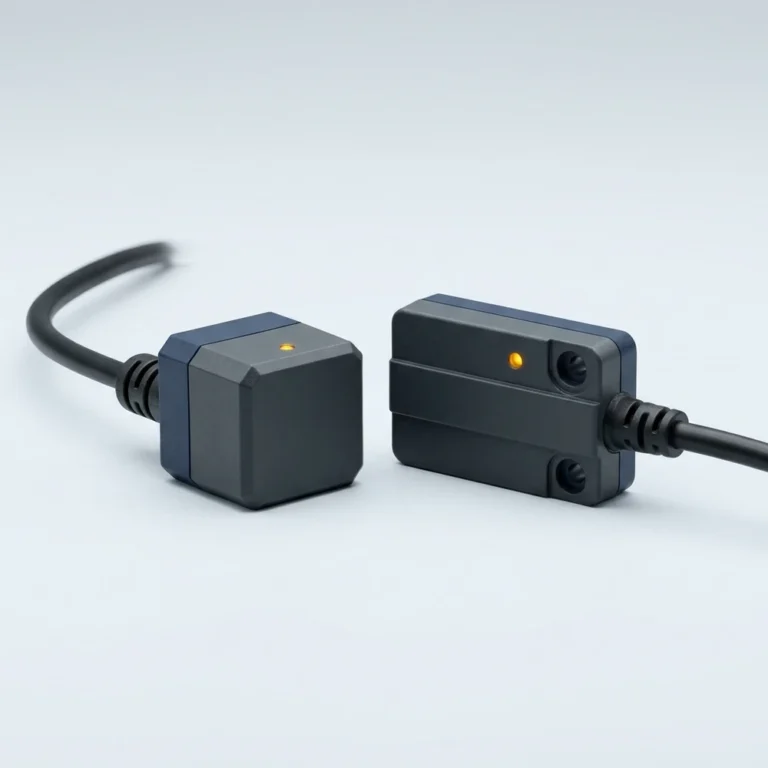
How to Choose an Industrial Sensor: Complete Engineering Selection Guide
Most sensor failures on OEM machines are selection errors, not component defects. Follow this five-step engineering workflow to match target physics, sensing distance, mounting clearance, PLC output, and IP sealing across all six industrial sensing families.
6 Sensing Families
96+ Catalog Series
IEC 60947-5-2 & 61496
Direct Factory Support
Engineering reality check: A sensor datasheet only guarantees performance against a standardized laboratory target at 23 °C in clean air. On a real machine, aluminum cuts inductive range by 60%, matte black rubber cuts diffuse optical range by 70%, and condensation turns a capacitive switch permanently on. Select by physics first, part number second.
1. Why Industrial Sensor Selection Fails When You Start with a Part Number
Machine builders and maintenance engineers rarely buy a bad sensor by accident — they inherit a part number from an older bill of materials, swap a target material from mild steel to 6061 aluminum, or relocate a bracket 3 mm closer to a steel frame, and then troubleshoot intermittent PLC inputs for two weeks. The root cause is almost always selecting by thread diameter or nominal sensing distance (Sn) alone instead of auditing the full sensing chain: target material, required air gap, ambient contamination, switching speed, and controller input logic.
This master selection guide gives control engineers, OEM designers, and technical buyers a repeatable five-step workflow to route any factory automation detection point to the right sensing technology — across inductive proximity, photoelectric, capacitive, magnetic, ultrasonic, and safety light curtain families — before requesting factory quotes or samples.
2. Six Industrial Sensing Technologies Compared
Every non-contact industrial sensor relies on a distinct physical field. Choosing the wrong field forces you to fight physics with fragile sensitivity tuning; choosing the right field delivers millions of maintenance-free cycles. Use the master matrix below to shortlist one primary family and one backup option before diving into individual dimensions or wiring.
| Sensing Family | Physical Principle | Reliable Targets | Typical Operating Range | Strengths | Primary Failure Modes | Deep Selection Manual |
|---|---|---|---|---|---|---|
| Inductive Proximity | High-frequency electromagnetic eddy currents | Ferrous & non-ferrous metals only | 0.8 mm – 40 mm (flush & non-flush) | Immune to oil, coolant, dust, ambient light, and non-metallic debris; up to 120 °C | Zero detection on plastics/liquids; range drops 55–65% on aluminum/copper | Inductive Selection Guide |
| Photoelectric & Optical | Modulated visible red, infrared, or laser light | Opaque, glossy, color-marked, or translucent solids | 10 mm – 30 m (mode dependent) | Long range, fast sub-millisecond response, tiny spot sizes (fiber & laser), background suppression | Lens fouling from heavy dust/oil mist; erratic diffuse range on matte black vs. glossy white | Photoelectric Selection Guide |
| Capacitive Proximity | Electrostatic capacitance shift via dielectric constant (εr) | Liquids, powders, plastics, glass, wood, and metals | 2 mm – 25 mm | Detects non-metals and reads liquid/pellet levels right through non-metallic tank walls | False triggering from heavy condensation, washdown spray, or conductive product buildup | Capacitive Selection Guide |
| Magnetic Proximity | Hall-effect IC or mechanical reed contact | Permanent magnets (NdFeB, ferrite, cylinder piston rings) | 10 mm – 70 mm (magnet dependent) | Sees directly through aluminum, brass, and 304 stainless steel walls; compact cylinder mounting | Requires an embedded magnet on the moving part; stray magnetic fields from welders | Hall vs. Reed Guide |
| Ultrasonic | High-frequency acoustic time-of-flight (200–400 kHz) | Clear glass, liquids, foams, dark rubber, powders, irregular solids | 30 mm – 6 m | Color-, transparency-, and gloss-independent; stable in airborne dust and ambient sunlight | Acoustic dead zone near face; soft sound-absorbing foam or severe air turbulence/steam | Ultrasonic vs. Photoelectric |
| Safety Light Curtains | Synchronized multi-beam infrared optoelectronic guard (IEC 61496) | Human fingers (14 mm), hands (20 mm), arms/body (40 mm) | 0.3 m – 20 m span | Fail-safe dual-channel OSSD outputs; fast operator access without mechanical doors | Must satisfy ISO 13855 stopping distance; does not stop flying sparks or ejected metal chips | Safety Curtain Guide |
3. Step-by-Step Five-Stage Engineering Selection Workflow
Work through these five engineering gates in exact sequence. Skipping directly to Step 4 (output wiring) or Step 5 (connector style) before locking Step 1 and Step 2 is the fastest way to order sensors that require mechanical rework on the shop floor.
Step 1: Audit Target Material, Geometry, and Background
- Is the target purely metallic at close range (≤ 40 mm)? Default immediately to an inductive proximity sensor. No optical lens can match an IP67 potted inductive barrel in cutting-oil or metal-chip environments. Remember to derate nominal ST37 range for stainless steel (0.70–0.85×), brass (0.45×), aluminum (0.40×), or copper (0.35×) using our Inductive Material Range Calculator.
- Is the target a non-metallic solid, granule, or liquid inside a plastic/glass vessel? Evaluate a capacitive proximity sensor when sensing distance is under 25 mm, or an ultrasonic sensor (such as the HU600-F42) when you need continuous analog level measurement from 50 mm to several meters.
- Is the target clear glass, shiny foil, or mixed dark/white packaging on a conveyor? Do not use a standard diffuse sensor. Choose polarized retroreflective, through-beam, or background-suppression (BGS) optics detailed in our photoelectric selection guide — or switch to ultrasonic for clear PET bottles and liquid surfaces.
- Is the target moving inside a sealed non-ferrous cylinder or behind an aluminum wall? Embed a permanent magnet and use a Hall-effect (HMH12) or reed-switch (MR12) magnetic sensor.
- Are you protecting a human operator at a press, robot cell, or palletizer entry? Standard photoelectric switches are legally prohibited for personnel safety. Specify an IEC 61496 safety light curtain with dual OSSD outputs.
Step 2: Calculate Real Assured Operating Distance (Sa), Not Nominal Sn
Nominal sensing distance (Sn) is a theoretical baseline that ignores manufacturing tolerance (±10%), temperature drift (±10%), target size reduction, and material correction factors. Under IEC 60947-5-2, the assured operating distance is at most Sa = 0.81 × Sr (where Sr is the material-corrected real switching distance).
Practical machine rule: keep the mechanical air gap between 50% and 70% of your material-corrected Sa. If a conveyor vibrates by ±1.5 mm and you need to detect 6061 aluminum, an M12 4 mm inductive sensor only gives 1.3 mm of assured range — too narrow for conveyor jitter. Stepping up to an M18 8 mm (LJ18A3-8) or long-range FR18 sensor adds the mechanical safety margin that eliminates line stoppages. For detailed inductive math, see our inductive sensing distance correction guide.
Step 3: Lock Housing Geometry, Mounting Style, and Clearance
- Cylindrical threaded barrels (M3 to M30): Easiest to mount and fine-tune with dual locknuts. Flush (shielded) barrels can sit level inside steel brackets; non-flush (unshielded) barrels deliver roughly 1.5–2× the range but require a metal-free keep-out zone of 3× barrel diameter around the sensing face. Review exact keep-out dimensions in Flush vs. Non-Flush Inductive Sensors.
- Rectangular, square, and flat housings: Choose square blocks (SN04, LF40) or thin flat profiles (TL-Q5MC1 / TL-W5MC1, HCF) when side-looking detection, tight gripper clearance, or surface-screw mounting beats threaded holes.
- Remote fiber-optic heads and ring housings: When the sensing zone sits inside an oven, tight die cavity, or micro-assembly head with zero space for electronics, mount a compact fiber head (FT / FRS) wired back to a DIN-rail amplifier (E3X / DP10), or drop small fasteners through a ring inductive sensor (HIR68).
Step 4: Match Electrical Output, Switching Logic, and Response Speed
Before issuing a purchase order, check the PLC input card datasheet — not just the supply voltage:
| Output Type | Wiring | Typical Supply | Best Matched Controller / Load | Key Selection Watch-Out |
|---|---|---|---|---|
| PNP (Sourcing) | DC 3-wire / 4-wire | 10–30 V DC | European / IEC 61131-2 sinking PLC cards (Siemens, Allen-Bradley, Beckhoff) | Standard for modern global OEM exports; ground fault cannot falsely energize PLC input |
| NPN (Sinking) | DC 3-wire / 4-wire | 10–30 V DC | Asian legacy sinking-output panels (Mitsubishi, Omron, Delta sourcing inputs) | Must match PLC common polarity; see NPN vs. PNP Wiring Guide |
| DC 2-Wire / AC 2-Wire | 2-wire series | 10–30 V DC or 90–250 V AC | Retrofit mechanical limit switches and direct relay coils | Watch residual off-state leakage current (0.8–1.7 mA) and voltage drop across the sensor |
| Analog (0–10 V / 4–20 mA) | DC 3-wire / 4-wire | 15–30 V DC | Continuous position, thickness, tension, or tank level feedback | Prefer 4–20 mA for cable runs > 10 m or high-EMI VFD environments |
| Dual-Channel OSSD | PNP self-checking pair | 24 V DC | Safety relay (SLC-SR) or safety PLC | Mandatory for personnel guarding; never wire into a standard non-safety PLC input alone |
Also check switching frequency (Hz) or response time (ms). If a gear tooth or bottle cap passes the sensing face at 120 parts per second (120 Hz), a 20 Hz AC inductive sensor will miss pulses. Use DC 3-wire inductive (300–2,000 Hz) or high-speed photoelectric/fiber sensors (≤ 0.5 ms response).
Step 5: Verify Environmental Sealing, Temperature, and Cabling
- Ingress protection: IP65 handles dry warehouse dust and light splashes (typical for safety light curtain housings). IP67 handles machine coolant, cutting oil, and temporary immersion (standard across HERED inductive, capacitive, and barrel photoelectric lines). High-pressure food/pharma caustic washdown requires stainless steel housings and chemical-resistant seals.
- Ambient temperature: Standard industrial sensors are rated −25 °C to +70 °C. Near injection molding barrels, ovens, or steel rolling lines (+80 °C to +120 °C), step directly into dedicated high-temperature inductive series (HIT05, HIT10, HIT25) or glass/heat-resistant fiber optics.
- Pre-wired PVC/PUR cable vs. M8/M12 quick-disconnect: Pre-wired 2 m cables minimize unit cost on stationary assemblies. Quick-disconnect M8 or M12 connectors paired with IP67 M8/M12 cordsets cut mean-time-to-replace (MTTR) from 30 minutes to 2 minutes on high-wear tooling and robotic arms.
4. Industry-to-Sensor Quick Routing Map
If you design equipment for a specific industrial vertical, start with the field-proven sensor combinations below:
| Application Sector | Primary Sensing Tasks | Recommended HERED Sensor Families |
|---|---|---|
| Packaging, Bottling & Labeling | Clear PET bottle counting, film registration marks, carton presence, cap verification | BGS & Color-Mark Photoelectric (HDB, KS, PM), Capacitive Level (HCL), Ultrasonic |
| CNC Machining, Stamping & Metal Fabrication | Tool clamp confirmation, cam/end-stop limits, press hand guarding, hot billet presence | Inductive Proximity (LR12, FR18, HIT10) + Safety Light Curtains (SLC-14, SLC-20) |
| Conveyors, Intralogistics & Warehousing | Tote/pallet zone accumulation, conveyor over-height gates, AGV bumper/docking | E3Z, E3JK, SLC-40, SLC-LR |
| Plastics, Chemical & Food/Grain Hoppers | Resin pellet hopper high/low level, sight-glass liquid monitoring, heated mold verification | CR18, CR30, HCL13, HITM15 |
| Electronics, SMT & Precision Assembly | Micro-component presence, PCB edge detection, screw-feeder drop counting, laser height check | LR04, E3X Fiber Amplifiers, HLD Laser Displacement, HIR68 Ring |
5. Where Single-Spec Selection Fails (Common Engineering Traps)
Trap 1: Ignoring Non-Ferrous Attenuation
Buying an M12 4 mm inductive sensor for a 2.5 mm gap on an aluminum fixture guarantees random missed triggers. Aluminum drops rated range to ~1.6 mm (assured ~1.3 mm). Always derate before sizing barrel diameter.
Trap 2: Using Diffuse Photoelectric on Mixed Colors
A standard diffuse switch tuned for white boxes will fail to see black tires or matte dark cartons at the same distance. Switch to Background Suppression (HDB), polarized retroreflective, or through-beam.
Trap 3: Mounting Non-Flush Sensors Flush in Steel
Surrounding an unshielded inductive or capacitive tip with steel immediately trips the output permanently on. Either leave a 3D metal-free collar or change to a flush-shielded series.
Trap 4: Confusing Through-Beam Optics with Safety Curtains
Standard industrial through-beam photoelectrics lack redundant self-checking OSSD circuits and cannot legally guard operator hands on presses or robots. Always specify IEC 61496 safety curtains.
6. What to Prepare Before Requesting a Sensor Quote
When you send an RFQ to Hered Electric’s engineering team, providing six concrete fields eliminates back-and-forth emails and lets us verify range margin before samples ship:
- Target material & dimensions: Exact alloy (carbon steel, 304 SS, aluminum), plastic/liquid type, or minimum object diameter (e.g., 14 mm finger vs. 20 mm hand).
- Required operating distance & mechanical tolerance: Nominal air gap plus conveyor vibration or fixture play.
- Housing & mounting constraint: Thread size (M4–M30), square/flat footprint, flush vs. non-flush bracket material.
- Electrical interface: Supply voltage (10–30 V DC or AC), output type (PNP, NPN, NO/NC, 0–10 V, 4–20 mA, or dual OSSD), and required switching frequency.
- Environment & connection: Ambient temperature, oil/washdown exposure, and pre-wired cable length vs. M8/M12 connector.
- Order volume or competitor reference: Prototype sample count, annual OEM run rate, or existing Omron/Sick/Pepperl+Fuchs/Autonics part codes for direct cross-reference.
7. Frequently Asked Questions on Industrial Sensor Selection
Which industrial sensor is the most reliable default when detecting metal parts?
An IP67 cylindrical inductive proximity sensor (such as the HERED LR12 or LR18 series) is the most reliable default for metallic targets under 40 mm. It has zero moving parts, resists cutting oil and dust, and is unaffected by target color or ambient factory lighting.
How do I choose between inductive, capacitive, and photoelectric sensors?
Use inductive when the target is metal within 40 mm; use capacitive when detecting non-metals, powders, or liquids within 25 mm (including through non-metallic tank walls); use photoelectric when you need sensing distances beyond 40 mm or precise optical spot positioning on conveyors. For close-range comparisons, see Inductive vs. Capacitive Proximity Sensors.
Should I standardize on NPN or PNP sensors for new OEM machines?
Most international OEM machines and modern IEC 61131-2 PLCs standardize on 24 V DC PNP (sourcing) sensors because a cable-to-ground fault blows a fuse rather than falsely energizing a PLC input. Confirm your PLC input card common wiring first, or check our NPN vs. PNP wiring guide.
When should I choose an analog sensor instead of a switching (ON/OFF) sensor?
Choose a switching sensor when you only need presence/absence, end-of-travel, or part counting. Choose an analog sensor (0–10 V or 4–20 mA, such as HIA inductive or HLD laser displacement) when the PLC must track exact distance, part thickness, web loop height, or tank level continuously.
Can Hered Electric cross-reference an existing Omron, Sick, or Pepperl+Fuchs BOM?
Yes. Send your current part list or target spec through the inline RFQ form below. Our engineers match thread geometry, flush/non-flush shielding, assured sensing range, output polarity, and M8/M12 pinout before recommending pin-compatible HERED series and sample pricing.
PUBLISHED HERED SERIES
Recommended All Industrial Sensors Series
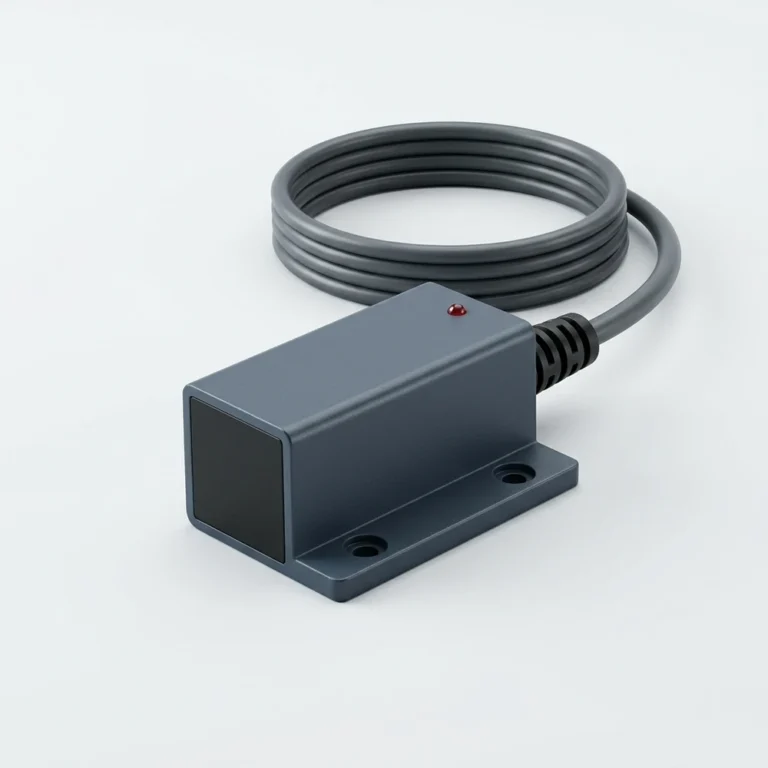
SN04-N / SN04-P Square Inductive Proximity Sensor (4 mm, 18×18 mm)
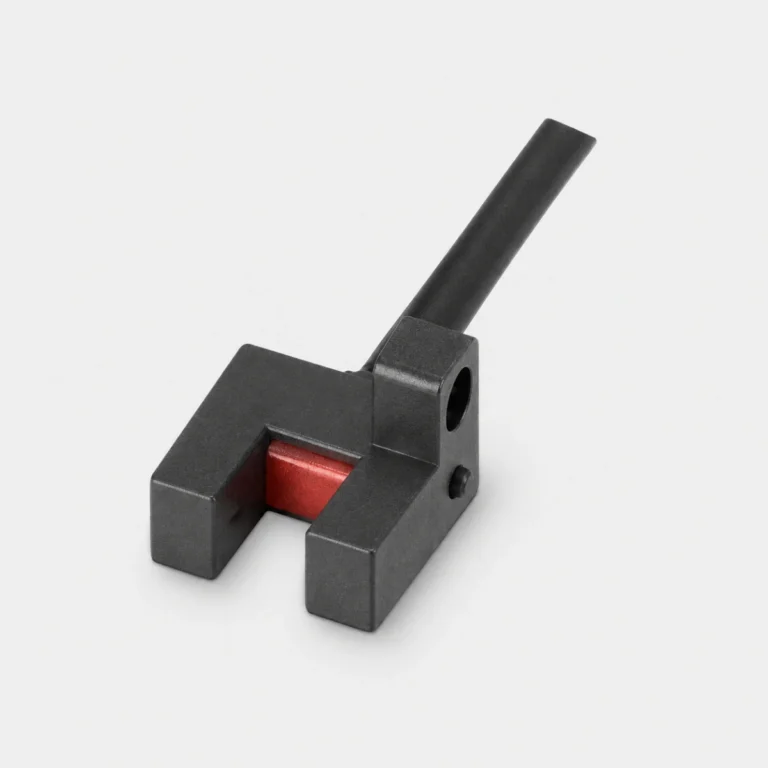
PM Series Compact Slot Photoelectric Sensor
PRC Series Diffuse-Reflective Fiber-Optic Sensor Head
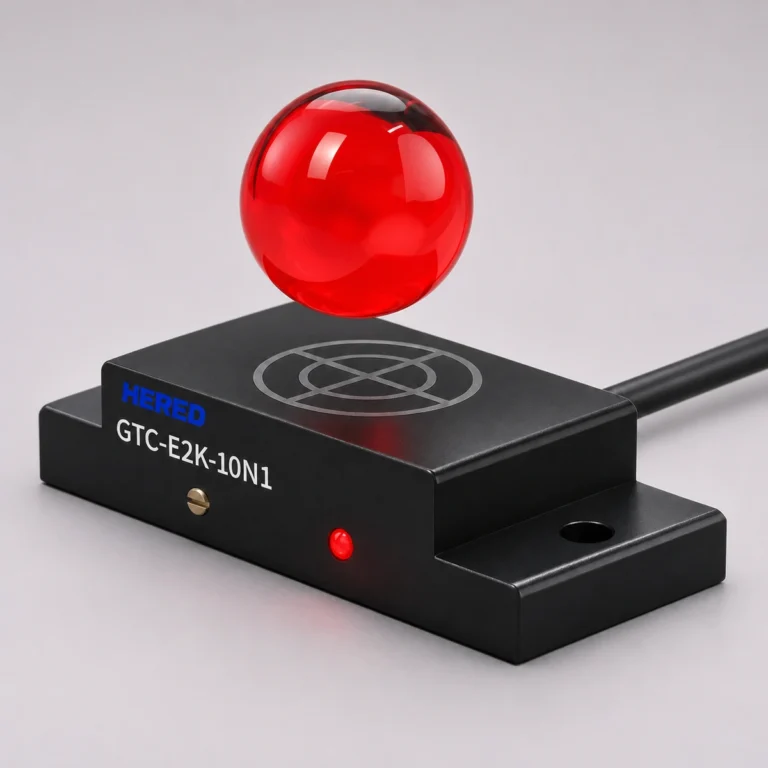
HCF Series Flat Capacitive Proximity Sensor
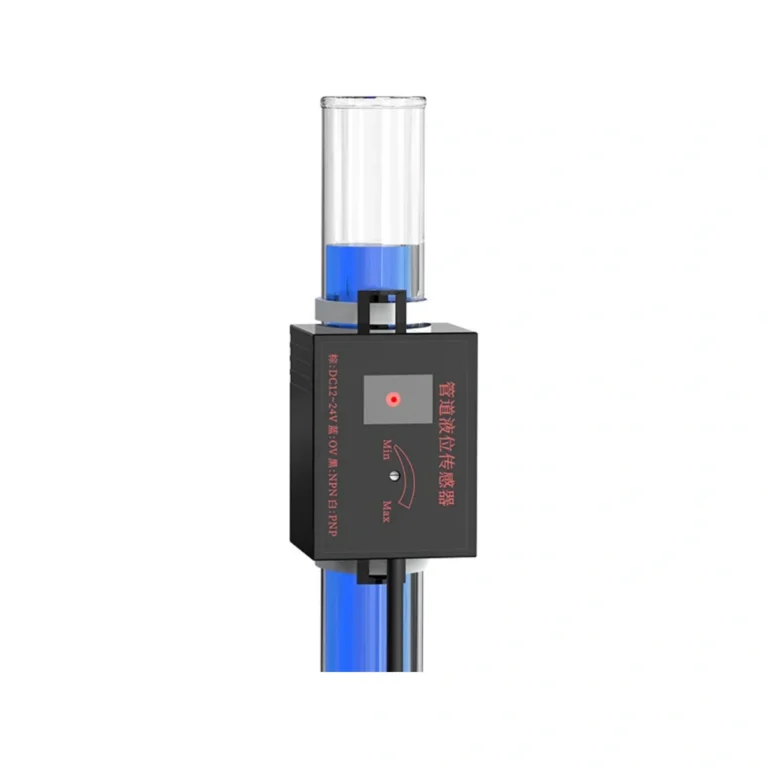
HCL Series Capacitive Liquid Level Sensor
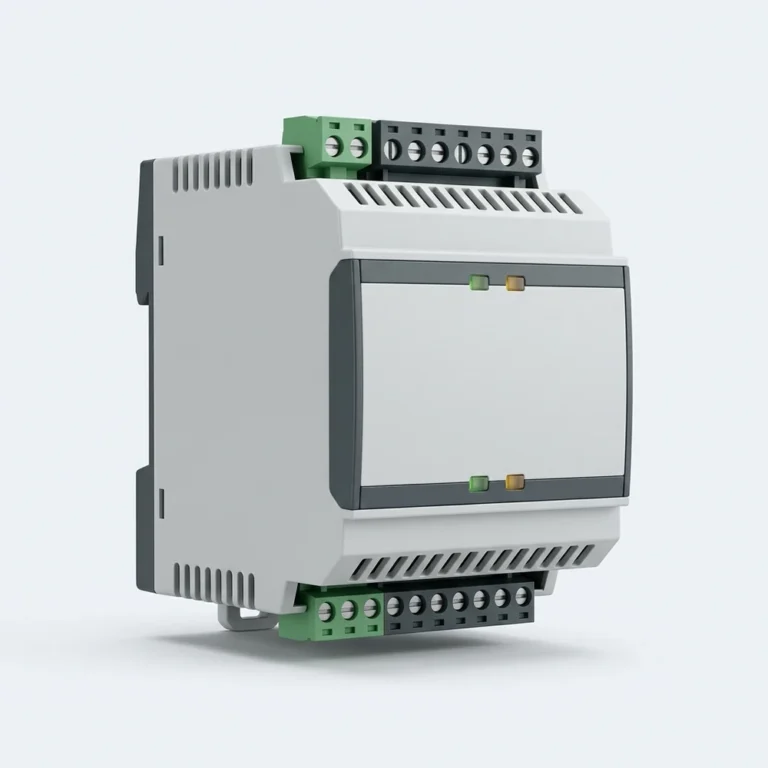
SLC-SR Dual-Output Safety Light Curtain Controller & Relay
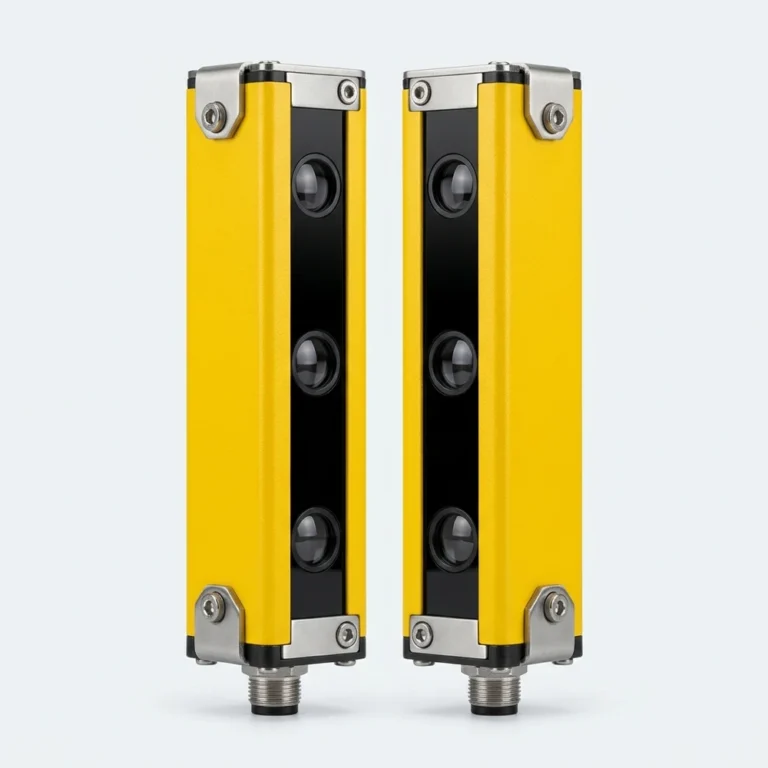
SLC-LR Multi-Beam Long-Range Safety Light Barrier
DEEP-DIVE TECHNICAL COMPARISONS
Related Engineering Articles
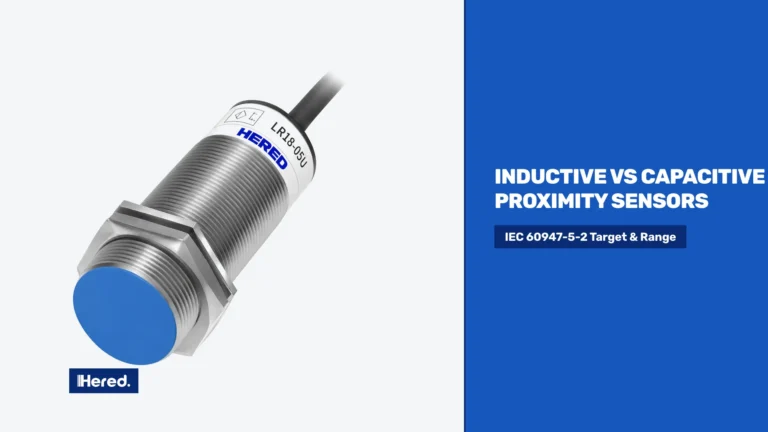
Inductive vs Capacitive Proximity Sensors: Target Materials, Range & Selection Guide
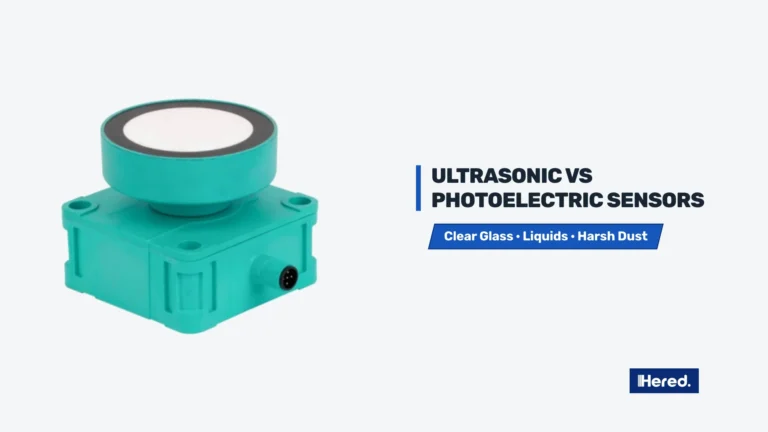
Ultrasonic vs Photoelectric Sensors: Detecting Clear Glass, Liquids & Harsh Dust
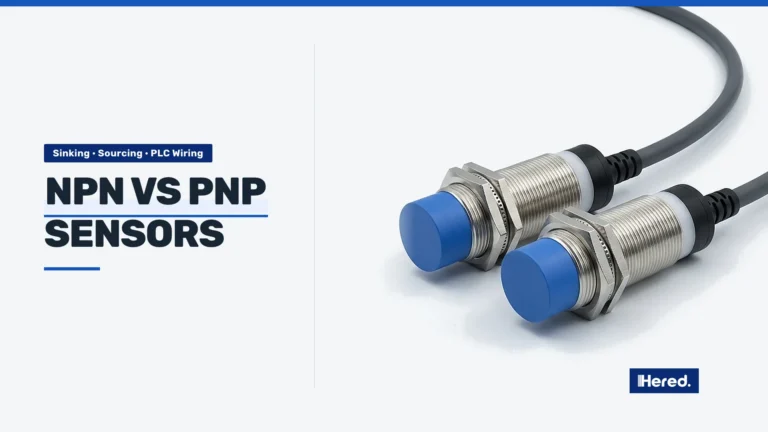
NPN vs PNP Sensors: Sinking vs Sourcing Output, PLC Wiring & Selection Guide
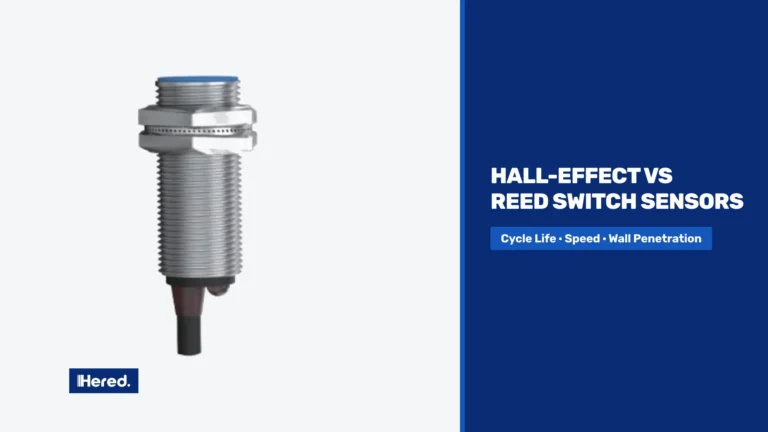
Hall-Effect vs Reed Switch Magnetic Proximity Sensors: Cycle Life, Speed & Wall Penetration
ENGINEERING RFQ & SAMPLE SUPPORT
Send Your Master Sensor Selection Guide Requirements for a Direct Factory Quote
Share the parameters from this guide (target material, required range, housing size, output type, and quantity). Hered Electric engineering reviews every inquiry before quoting.
- Fast cross-reference: Send Omron, Sick, Pepperl+Fuchs, Autonics, or Turck part codes for pin-compatible HERED series.
- No-guesswork sizing: Include target metal/medium, mounting clearance, and PLC input type (sinking/sourcing).
- Direct contact: [email protected] · WhatsApp +86 180 6639 6588