
Ultrasonic vs Photoelectric Sensors: Detecting Clear Glass, Liquids & Harsh Dust
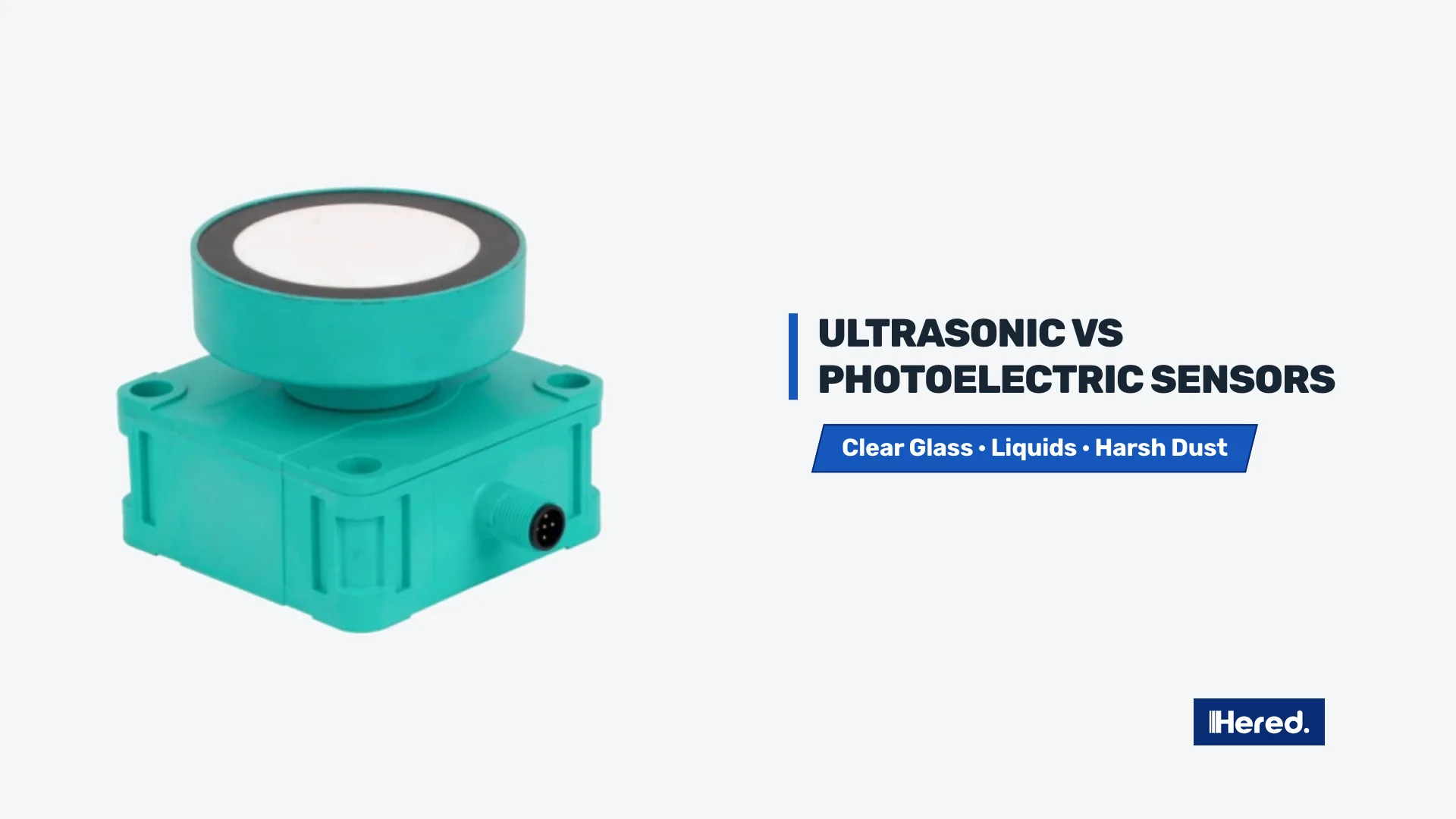
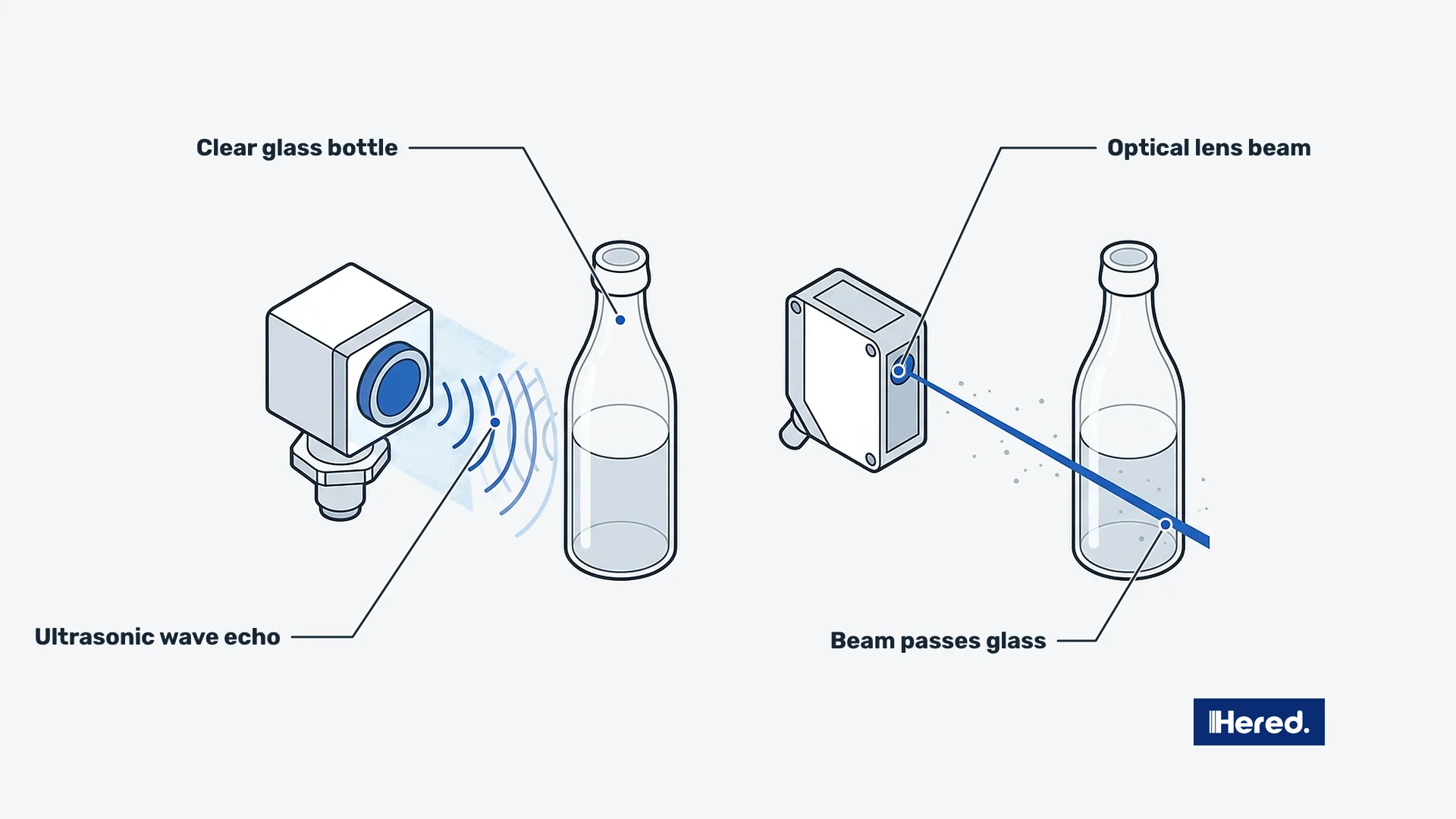
Ultrasonic sensors emit high-frequency sound pulses (typically 40–400 kHz) and measure echo time-of-flight to detect clear glass, transparent films, liquids, and dark matte surfaces regardless of color or gloss, whereas photoelectric sensors emit light beams that deliver far faster switching speeds and zero transducer blind zone on opaque objects but fail on clear targets unless specialized polarized optics are used. Specifying an ultrasonic sensor on sound-absorbing foam or high-speed conveyor counting causes missed echoes and slow response, while specifying a standard diffuse photoelectric sensor on clear PET bottles or dusty grain bins causes chronic false triggers.
Under IEC 60947-5-2, choosing between ultrasonic and photoelectric proximity switches comes down to five physical boundaries: target transparency and color variability, acoustic absorption (foam or textiles), airborne dust or air turbulence, minimum near-face blind zone clearance, and required response speed.
Acoustic Time-of-Flight vs. Optical Beam Physics
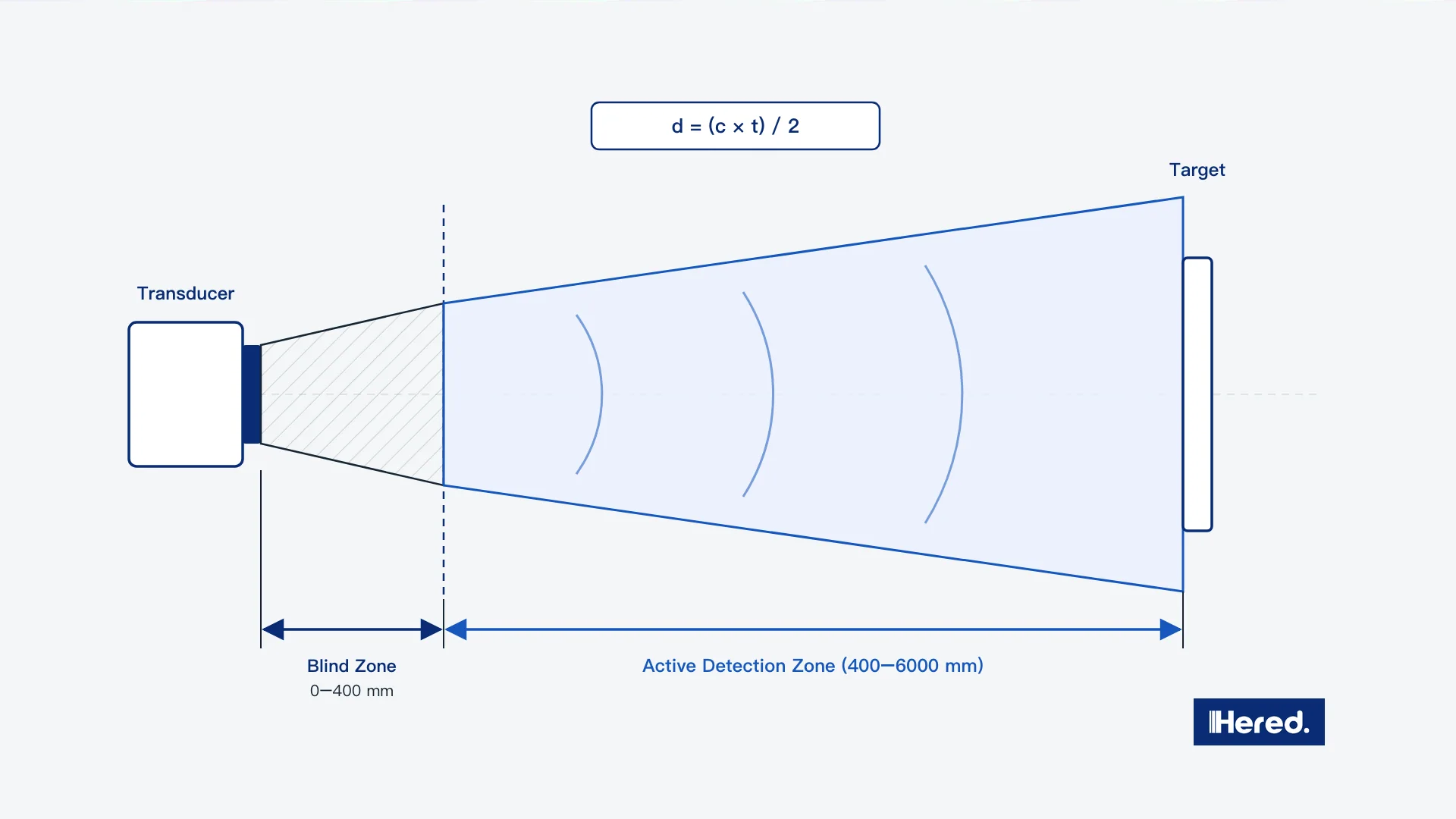
Ultrasonic sensors use a piezoelectric ceramic transducer that alternates between transmitting a brief acoustic burst and listening for the returning echo, calculating target distance as d = (c × t) / 2 where c is the speed of sound in air and t is the round-trip echo time. Photoelectric sensors transmit continuous modulated infrared, visible red, or laser light and evaluate beam interruption or reflected light intensity (detailed in our Through-Beam vs Retroreflective vs Diffuse Photoelectric Sensors Guide).
| Engineering Criterion | Ultrasonic Sensor | Photoelectric Sensor | Practical Selection Impact |
|---|---|---|---|
| Sensing medium | High-frequency acoustic waves (sound) | Modulated LED or laser light | Sound ignores color; light ignores foam |
| Clear glass, PET film & liquids | Excellent (reflects off any dense surface) | Poor on standard diffuse; needs clear-object optics | Ultrasonic wins on clear bottles & tank levels |
| Matte-black or multi-color targets | Identical range across all colors | Diffuse range drops 50%–70% on black | Ultrasonic or HDB background suppression |
| Foam, cotton & acoustic fabrics | Poor (absorbs sound energy) | Excellent (opaque to light) | Never use ultrasonic on soft foam or cloth |
| Airborne dust, mist & dirty face | High tolerance to mild airborne dust | Lens grime & dense dust blind optics fast | Ultrasonic or high-gain through-beam |
| Near-face blind zone (dead band) | Mandatory (20 mm to 400 mm+) | Negligible on most models | Ultrasonic cannot detect objects against face |
| Typical response time | 20 ms to 650 ms (range dependent) | 0.5 ms to 20 ms | High-speed bottle counting favors photoelectric |
| Air drafts & temperature gradients | Speed of sound shifts ~0.17% per °C | Completely immune to air currents | Hot ovens & air knives disrupt ultrasonic |
Choose an ultrasonic sensor whenever you must measure continuous liquid or bulk-solid level, detect transparent glass or clear films without an opposite reflector, or operate in dusty bins where optical lenses foul rapidly; switch to a photoelectric sensor whenever targets move at high speed, sit within a few centimeters of the sensor face, consist of sound-absorbing foam or textiles, or pass through strong compressed-air blow-off streams.
Understanding the Ultrasonic Blind Zone (Dead Band) and Speed-of-Sound Drift
Every single-transducer ultrasonic sensor exhibits a mandatory near-face blind zone (also called dead band) immediately in front of the ceramic face. After transmitting a high-voltage acoustic burst, the piezoelectric disc continues to ring mechanically for a brief decay interval during which the receiver cannot listen without mistaking its own vibration for a target echo. Longer-range low-frequency transducers require larger ring-down margins: for example, a 6-meter long-range industrial unit such as the HERED HU600-F42 has an active detection zone from 400 mm to 6,000 mm and a 0–400 mm dead band.
Temperature Compensation and Target Angle Limits
Because the speed of sound in dry air increases with temperature according to c ≈ 331.3 + 0.606 × T (in m/s, where T is ambient temperature in °C), a 30°C swing between winter morning startup and summer afternoon shifts an uncompensated distance reading by roughly 5%. Industrial ultrasonic sensors incorporate internal temperature compensation to correct uniform ambient drift, though sharp thermal layers—such as rising steam above a hot tank—still bend acoustic waves and reduce accuracy.
In addition, smooth flat targets (like calm liquid surfaces or glass panes) must sit within roughly ±3 degrees of perpendicular to the ultrasonic beam axis; tilting a smooth sheet too steeply deflects the sound wave away from the transducer like a mirror, causing echo loss even at short range.
Hardware Anatomy of a Long-Range Industrial Ultrasonic Sensor
Long-range ultrasonic level and bulk-detection sensors use a large-diameter piezoelectric transducer face to achieve narrow acoustic beam divergence across multi-meter spans, paired with a rotatable head or multi-bore base so technicians can aim the acoustic cone straight down into silos, hoppers, or wide conveyor lanes.
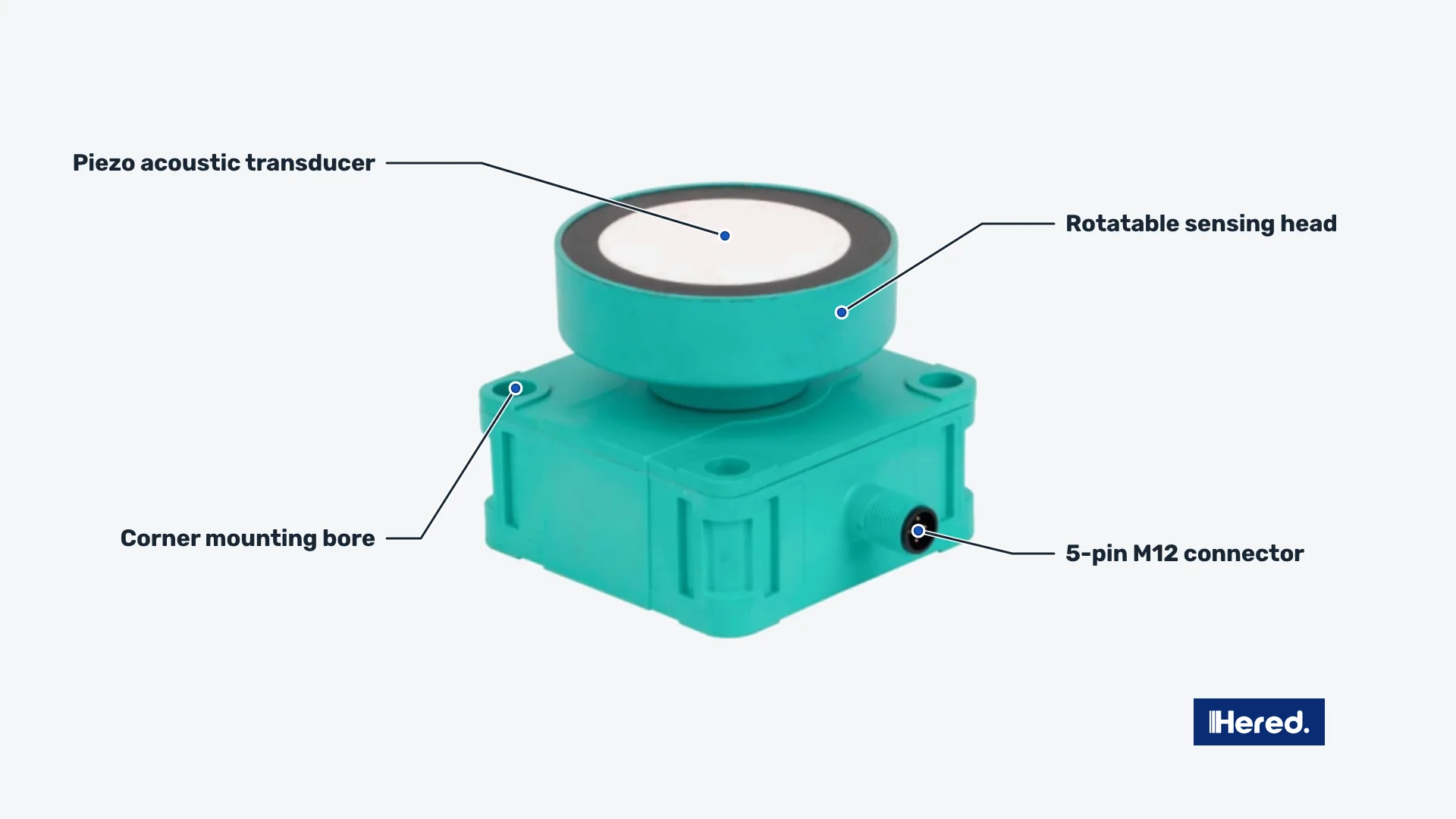
Matching HERED Ultrasonic and Photoelectric Series to Your Machine
Across the HERED Ultrasonic Sensors and HERED Photoelectric Sensor Manufacturer Hub, matching acoustic versus optical series to the exact target boundary prevents costly field retrofits:
| HERED Series | Technology | Verified Catalog Range & Dead Band | Supply & Output | Enclosure & Best-Fit Application |
|---|---|---|---|---|
| HERED HU600-F42 | Long-Range Ultrasonic | 400–6,000 mm (0–400 mm dead band) | 20–250 V AC, one relay output, 5-pin M12 / 2 m cable | IP54, ≤ 0.5% repeatability · Liquid level, bulk silos & clear targets |
| HERED E3JK Series | Through-Beam / Retro Photoelectric (11 models) | 4 m to 40 m (near-zero dead band) | 24–240 V AC/DC SPDT 5-wire relay | IP64 · Long conveyor lanes, opaque cartons & harsh dust (through-beam) |
| HERED E3Z Series | Compact Photoelectric | Compact conveyor spans | 10–30 V DC NPN / PNP | Compact rectangular · Fast bottling & packaging lines |
| HERED HDB Series | Background Suppression Photoelectric (22 models) | 30–300 mm, 0–400 mm, 0–600 mm (adj.) | 12–24 V DC 4-wire NPN / PNP NO/NC | IP50 / IP65 · Mixed dark/light solid parts near shiny machine rails |
Choose HERED HU600-F42 for multi-meter liquid level, grain or aggregate silos, and clear glass or film detection where you can maintain at least 400 mm of mounting clearance above the target; switch to HERED E3JK, HERED E3Z, or HERED HDB whenever response time under 20 ms, soft foam/textile detection, or close-range mounting is required.
Frequently Asked Questions
Why can an ultrasonic sensor detect clear glass bottles when a standard photoelectric sensor misses them?
Optical light passes directly through transparent glass and clear plastic film with very little diffuse reflection, so a standard photoelectric receiver sees no target. Ultrasonic waves reflect off acoustic impedance changes between air and any solid or liquid barrier, producing a strong echo from clear glass regardless of transparency or color.
What happens if a target enters an ultrasonic sensor’s blind zone (dead band)?
Inside the blind zone (for example, 0–400 mm on a 6-meter HU600-F42 sensor), the transducer is still ringing from its outgoing pulse and cannot reliably distinguish returning echoes. Targets inside the dead band can trigger erratic outputs or drop out completely, so always mount the sensor far enough back that the highest target level stays outside the blind zone.
Can an ultrasonic sensor work in a vacuum or on foam packaging?
No. Ultrasonic sensors require air or another gas medium to propagate sound waves, so they cannot operate in a vacuum chamber. Similarly, open-cell foam, cotton, wool, and aerated liquid foam absorb or scatter acoustic waves instead of reflecting a crisp echo; use a photoelectric sensor (such as through-beam E3JK or background suppression HDB) for foam and textile targets.
References
- International Electrotechnical Commission (IEC), IEC 60947-5-2:2019 — Low-voltage switchgear and controlgear — Part 5-2: Control circuit devices and switching elements — Proximity switches, IEC Webstore.
- International Electrotechnical Commission (IEC), IEC 60529 — Degrees of protection provided by enclosures (IP Code), IEC Webstore.
- HERED Electric, Ultrasonic & Photoelectric Sensor Catalog (HU600-F42, E3JK, E3Z, HDB), HERED Electric.
Need help selecting the right industrial sensor?
Explore our 1,152+ catalogued inductive, photoelectric, capacitive, and magnetic proximity sensors or request factory cross-reference support.
DIRECT FACTORY RFQ
Need sensor pricing, samples, or OEM cross-reference?
Share your target material, sensing distance, NPN/PNP output, or model code. Our engineering team replies within 24 hours.