
Inductive vs Capacitive Proximity Sensors: Target Materials, Range & Selection Guide
Inductive proximity sensors generate a high-frequency electromagnetic field to detect electrically conductive metals only—ignoring plastics, water, dust, and cutting oil—whereas capacitive proximity sensors generate an electrostatic field that detects both metals and non-metallic targets such as liquids, plastic pellets, glass, wood, and powders. Choosing a capacitive sensor where an inductive sensor belongs causes false triggers from coolant spray and humidity, while specifying an inductive sensor on a non-metallic target yields zero output.
Under IEC 60947-5-2, the choice between inductive and capacitive proximity switches is governed by four physical factors: whether the target is metallic or dielectric, whether the sensor must look through a non-metallic container wall, how much moisture or buildup surrounds the sensing face, and the required switching frequency.
How Inductive and Capacitive Proximity Sensors Work Internally
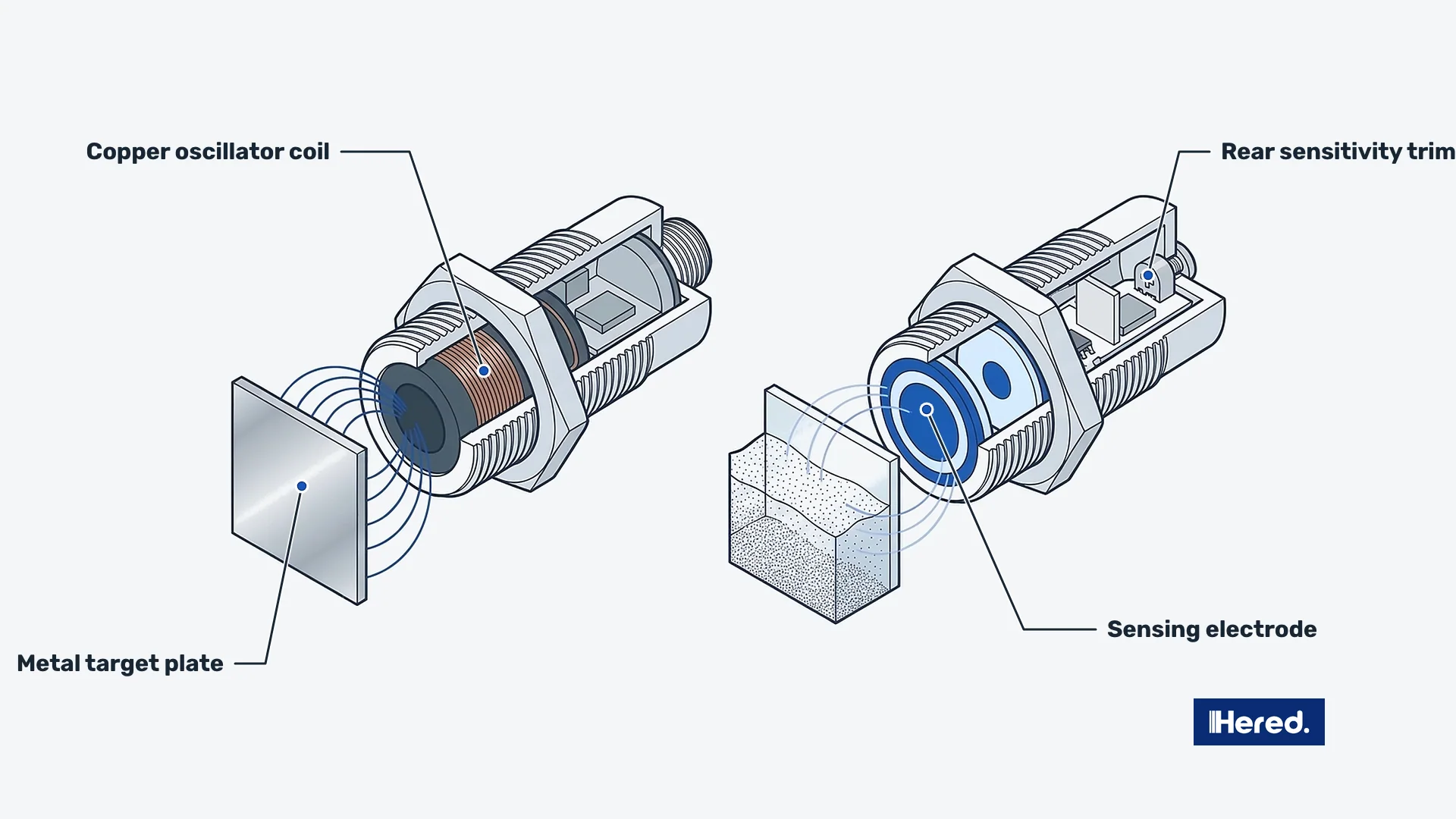
Inductive proximity sensors house a wound copper coil inside a ferrite cup core at the front face that creates an oscillating magnetic field; when a metal object enters that field, induced eddy currents drain oscillator energy and trigger the output stage. Capacitive proximity sensors replace the coil with a flat concentric sensing electrode and compensation ring that form an open capacitor plate; when any material with a relative dielectric constant greater than air enters the electrostatic field, capacitance increases until the oscillator starts and switches the output.
| Engineering Criterion | Inductive Proximity Sensor | Capacitive Proximity Sensor | Governing Standard / Physics |
|---|---|---|---|
| Primary sensing field | High-frequency electromagnetic field | Open-plate electrostatic field | IEC 60947-5-2 |
| Detectable target materials | Ferrous and non-ferrous metals only | Metals, liquids, plastics, glass, wood, powders | Eddy currents vs. dielectric constant |
| IEC 60947-5-2 rated target | 1 mm square Fe360 carbon steel | Grounded 1 mm square Fe360 carbon steel | IEC 60947-5-2 |
| Typical M18 nominal range (Sn) | 5 mm (flush) to 8–16 mm (non-flush) | 5 mm to 10 mm (adjustable) | Barrel size & mounting dependent |
| Typical switching frequency | 200 Hz to 2,000 Hz+ | 10 Hz to 100 Hz | Oscillator settling time |
| Sensitivity adjustment | Fixed factory threshold | Multi-turn rear potentiometer on most models | Needed for dielectric / wall tuning |
| Coolant, moisture & dust immunity | Excellent (ignores water, oil, plastic chips) | Sensitive to condensation and wet buildup | Electrostatic field responds to water |
Choose an inductive proximity sensor whenever the target is metal and the environment contains cutting fluid, washdown water, non-metallic dust, or high-speed moving parts above 100 Hz; switch to a capacitive proximity sensor whenever the target is plastic, glass, wood, grain, powder, or liquid—especially when sensing through a non-metallic tank wall.
Target Material Reduction Factors: Metals vs. Dielectric Constants
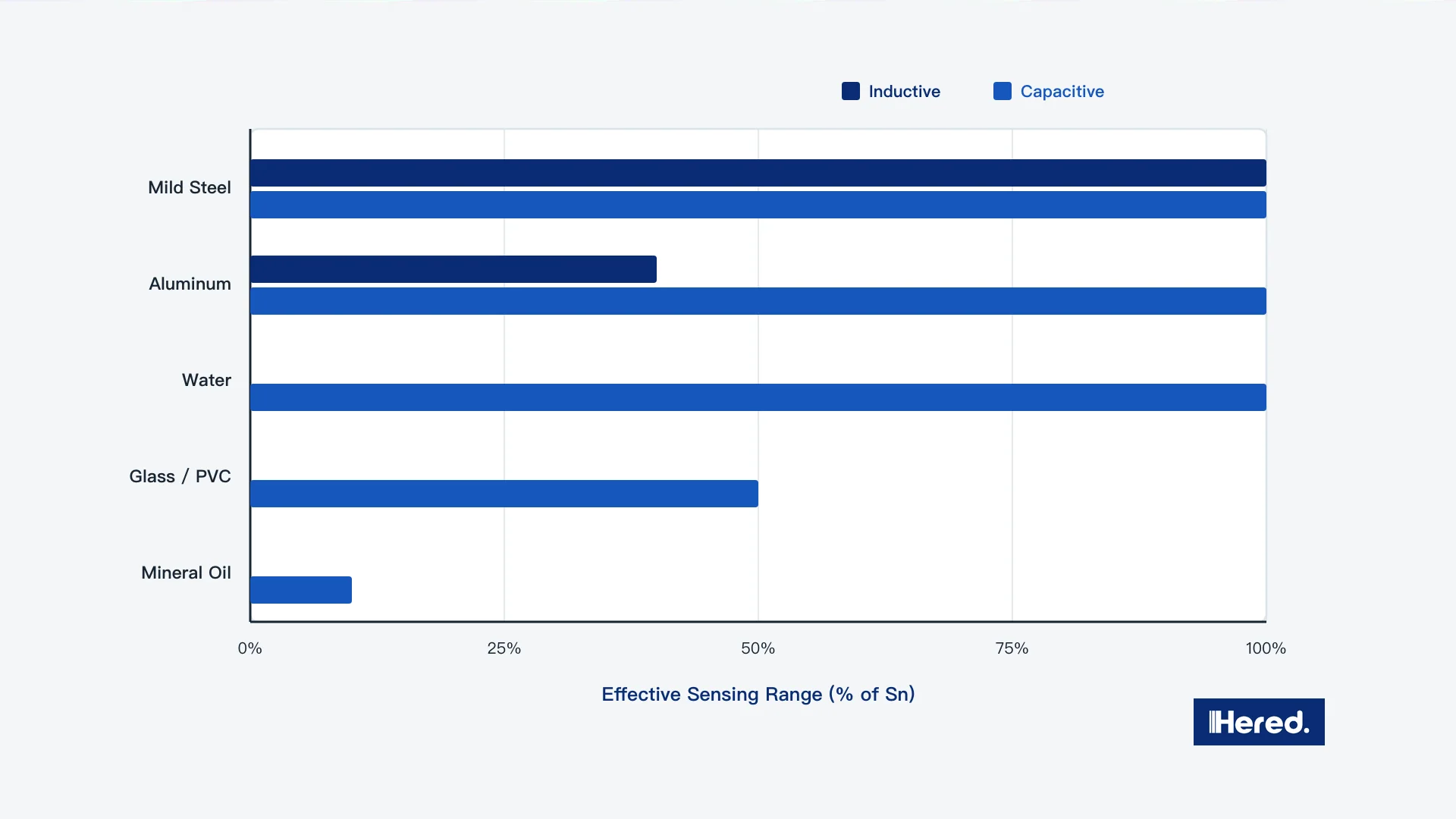
Both inductive and capacitive sensors require derating the datasheet nominal sensing distance (Sn) whenever the real target differs from the IEC 60947-5-2 mild-steel test plate. However, the underlying physics behaves in opposite directions: inductive range depends on electrical conductivity and magnetic permeability (detailed in our Inductive Sensor Sensing Distance Guide), whereas capacitive range depends on the target’s relative dielectric constant compared to air (1.0).
| Target Material | Relative Dielectric Constant (εr) | Inductive Effective Range (% of Sn) | Capacitive Effective Range (% of Sn) | Practical Engineering Implication |
|---|---|---|---|---|
| Mild steel (Fe360, grounded) | Conductive (baseline) | 100% (1.00×) | 100% (1.00×) | Full catalog range on both technologies |
| Aluminum / copper | Conductive | 30%–45% (0.30×–0.45×) | 100% (1.00× if grounded) | Inductive needs extended range; capacitive holds full Sn |
| Water / aqueous liquids | Approx. 80 | 0% (not detected) | 100% (1.00×) | Capacitive easily detects water through plastic/glass walls |
| Glass / quartz | 3.7 to 10 | 0% (not detected) | 40%–50% (0.40×–0.50×) | Reliable vial, bottle, and sight-glass presence detection |
| PVC / hard plastics | 3 to 5 | 0% (not detected) | 50%–60% (0.50×–0.60×) | Detectable directly or tuned out as thin container walls |
| Mineral or hydraulic oil | 2 to 4 | 0% (not detected) | Approx. 10% (0.10×) | Low dielectric sharply cuts capacitive range; test on media |
Choose an inductive sensor for aluminum or steel targets on metalworking and packaging machinery so coolant splashes never cause false trips; switch to a capacitive sensor with a multi-turn sensitivity potentiometer for water, glass, PVC, wood, or dry pellets, and always validate low-dielectric oils or dry powders with real production samples before locking the mounting distance.
Through-Wall Liquid Level Sensing and Environmental Failure Modes
A major advantage of capacitive proximity sensors is non-invasive level detection through non-metallic container walls, which eliminates tank drilling, wetted gaskets, and chemical corrosion. Because water has a dielectric constant around 80 while PVC or glass walls sit near 3 to 10, an engineer can mount a capacitive sensor directly against the outside of a plastic or glass vessel and turn the rear sensitivity potentiometer down until the empty tank wall produces no signal, leaving ample margin to trigger cleanly when liquid rises behind the wall.
Why Conductive Metal Walls and Wet Buildup Defeat Capacitive Sensors
Capacitive sensors cannot see through grounded steel or aluminum tank walls because conductive metal shields the electrostatic field completely. Likewise, if humid condensation, conductive foam, or wet flour coats the front face of a capacitive sensor, the sensor interprets that surface film as a high-dielectric target and locks in the ON state. On wet or dusty hoppers, mount the sensor slightly angled so droplets shed off the face, keep the potentiometer tuned just above the empty-wall margin, and verify flush versus non-flush bracket rules (see our Flush vs Non-Flush Inductive Sensors Guide for metallic mounting clearance principles).
Physical Housing Differences and Wiring Compatibility
Externally, M18 and M30 cylindrical inductive and capacitive sensors share identical mounting threads, locknuts, and 24 V DC NPN/PNP or 2-wire AC electrical interfaces, allowing machine builders to use the same panel wiring standards across both families. The visible hardware cues sit at the two ends of the barrel: inductive sensors typically use a sealed PBT front cap with a fixed factory threshold, whereas cylindrical capacitive sensors feature an ABS or PTFE sensing face paired with a rear sensitivity adjustment screw and status LED.
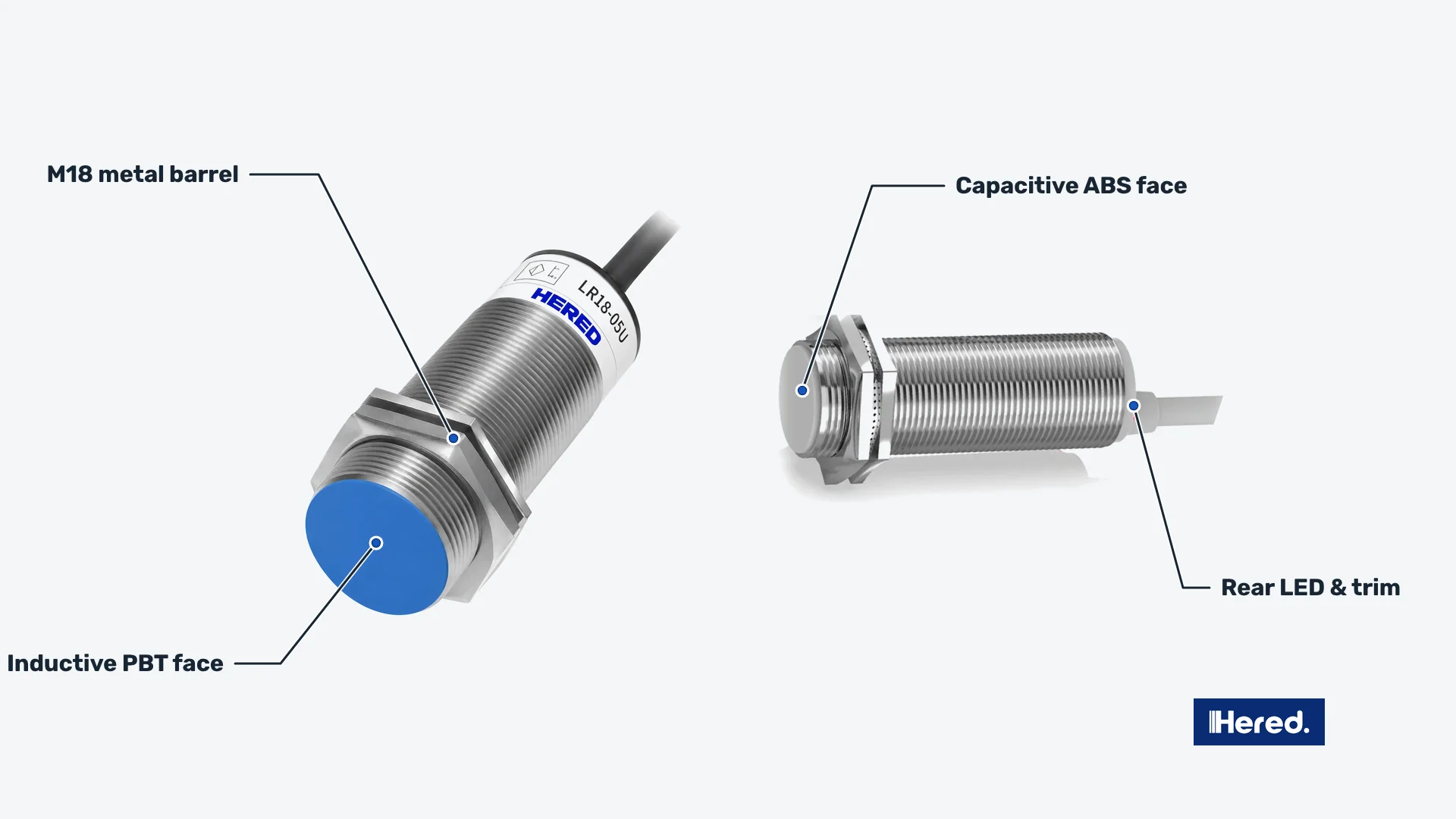
For PLC integration, both inductive and capacitive families follow identical IEC 60947-5-2 brown (+V), blue (0 V), and black (output) wire colors; verify your PLC digital input card common rail in our NPN vs PNP Sensors Wiring Guide before ordering.
Matching HERED Inductive and Capacitive Series to Your Application
Across the HERED Inductive Sensor Manufacturer Hub and HERED Capacitive Sensor Manufacturer Hub, five flagship series cover standard cylindrical, large-barrel hopper, flat tank-wall, and non-invasive pipe-level applications:
| HERED Series | Technology | Verified Catalog Range | Supply & Output Options | Enclosure & Best-Fit Application |
|---|---|---|---|---|
| HERED LR18 Series | Inductive (36 models) | 5 mm / 8 mm ± 10% (flush & non-flush) | 15–30 V DC / 90–250 V AC; NPN, PNP, 2-wire, analog | IP67 · General metal detection on CNC & conveyors |
| HERED CR18 Series | Capacitive (24 models) | 5 mm / 10 mm ± 10% | 10–30 V DC NPN/PNP & 90–250 V AC 2-wire | IP65 · Plastic pellets, cartons, glass & compact tanks |
| HERED CR30 Series | Capacitive (24 models) | 10 mm / 20 mm ± 10% | 10–30 V DC NPN/PNP & 90–250 V AC 2-wire | IP65 · Feed hoppers, grain silos & thicker plastic walls |
| HERED HCF Series | Flat Capacitive (4 models) | 10 mm (adjustable) | 10–30 V DC 3-wire NPN/PNP NO/NC | IP67 · Flush mounting directly against sight glasses & chutes |
| HERED HCL13 Series | Pipe Liquid Level (2 models) | Non-invasive outer pipe | 12–24 V DC, NO/NC | IP66 · Liquid presence on external plastic or glass tubing |
Choose the HERED LR18 Series for high-speed metallic detection in coolant, oil, or washdown zones; switch to HERED CR18 or HERED CR30 for bulk solids and hoppers, and specify HERED HCF or HERED HCL13 when mounting directly against flat sight glasses or outer liquid tubing.
Frequently Asked Questions
Can a capacitive proximity sensor replace an inductive sensor for metal detection?
Technically a capacitive sensor can detect grounded metal at full rated range, but it is a poor replacement for an inductive sensor in wet, oily, or high-speed metalworking environments. Capacitive sensors switch much slower (typically 10–100 Hz versus 500–2,000 Hz for inductive) and false-trigger on water droplets, cutting oil, or plastic debris that an inductive sensor completely ignores.
Why must the container wall be non-metallic for through-wall capacitive level sensing?
An electrostatic field terminates on any grounded or conductive metal sheet, so a steel or aluminum tank wall blocks a capacitive sensor from seeing the liquid inside. Through-wall capacitive level sensing requires a non-metallic wall such as PVC, polypropylene, PTFE, or glass whose dielectric constant is lower than the liquid being monitored.
What happens if the target material is mineral oil or dry plastic powder?
Mineral oil and dry plastic powders have low relative dielectric constants (roughly 2 to 4), which reduces a capacitive sensor’s effective range to roughly 10%–35% of its rated Sn. Choose a larger M30 barrel (such as HERED CR30) for higher baseline range, mount the sensing face as close as possible to the media, and calibrate the sensitivity potentiometer with the actual material.
References
- International Electrotechnical Commission (IEC), IEC 60947-5-2:2019 — Low-voltage switchgear and controlgear — Part 5-2: Control circuit devices and switching elements — Proximity switches, IEC Webstore.
- International Electrotechnical Commission (IEC), IEC 60529 — Degrees of protection provided by enclosures (IP Code), IEC Webstore.
- HERED Electric, Inductive & Capacitive Proximity Sensor Manufacturer Hubs (LR18, CR18, CR30, HCF, HCL13), HERED Electric.
Need help selecting the right industrial sensor?
Explore our 1,152+ catalogued inductive, photoelectric, capacitive, and magnetic proximity sensors or request factory cross-reference support.
DIRECT FACTORY RFQ
Need sensor pricing, samples, or OEM cross-reference?
Share your target material, sensing distance, NPN/PNP output, or model code. Our engineering team replies within 24 hours.