
Hall-Effect vs Reed Switch Magnetic Proximity Sensors: Cycle Life, Speed & Wall Penetration
Solid-state Hall-effect magnetic proximity sensors contain zero moving parts, deliver virtually unlimited cycle life (exceeding 1 billion operations) with bounce-free switching above 10 kHz, and require continuous 10–30 V DC power, whereas electromechanical reed-switch magnetic proximity sensors seal two ferromagnetic metal blades inside a glass capsule to provide zero-leakage AC/DC 2-wire dry-contact switching at the cost of mechanical wear, contact bounce, and slower speed. Specifying a reed switch on a high-speed indexing line causes premature contact welding and double-count pulses, while specifying a 3-wire DC Hall sensor on a legacy AC relay panel forces an unnecessary power-supply retrofit.
Choosing between Hall-effect and reed-switch magnetic sensors depends on four practical engineering constraints: expected switching cycles and vibration severity, maximum target speed and PLC input debounce limits, available AC or DC supply voltage, and the metallurgy of any barrier wall between the magnet and the sensor.
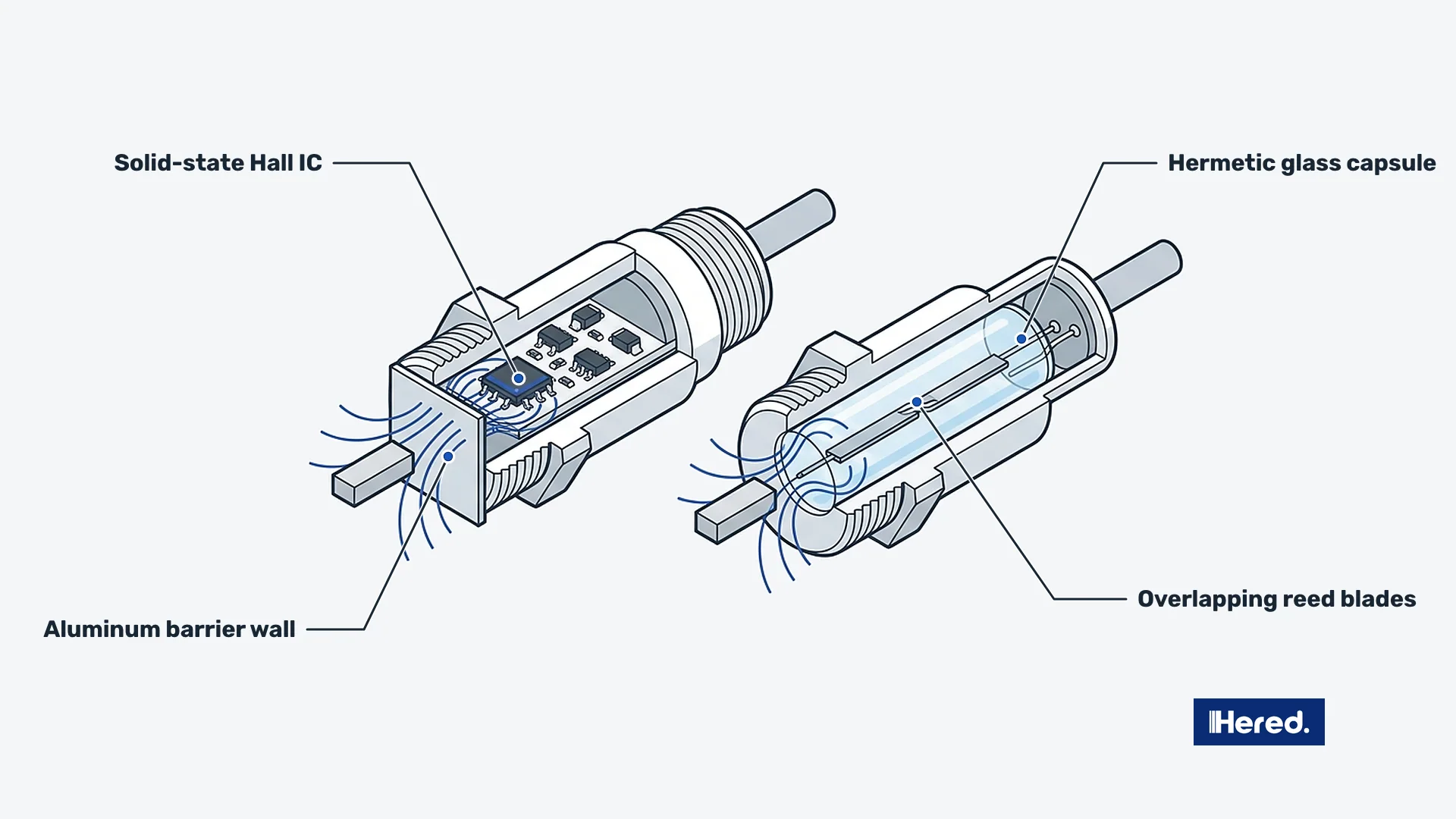
Internal Construction: Solid-State Hall IC vs. Hermetic Glass Reed Capsule
Hall-effect magnetic proximity sensors use a silicon semiconductor element mounted on an internal PCB that develops a transverse Hall voltage proportional to magnetic flux density, driving a solid-state NPN or PNP output transistor without physical contact movement. Reed-switch magnetic proximity sensors house two overlapping nickel-iron blades inside an inert-gas glass tube that physically flex and snap closed when external magnetic flux bridges the contact gap.
| Engineering Criterion | Hall-Effect Magnetic Sensor | Reed-Switch Magnetic Sensor | Engineering Impact |
|---|---|---|---|
| Sensing technology | Solid-state silicon Hall IC + transistor | Electromechanical ferromagnetic blades in glass | Zero wear vs. mechanical contact fatigue |
| Typical cycle life | Over 10⁹ cycles (virtually infinite) | 10⁶ to 10⁸ cycles (load dependent) | High-cycle machinery favors Hall-effect |
| Maximum switching frequency | Up to 10–100 kHz+ | Typically 200 Hz to under 2 kHz | High-RPM shafts require Hall-effect |
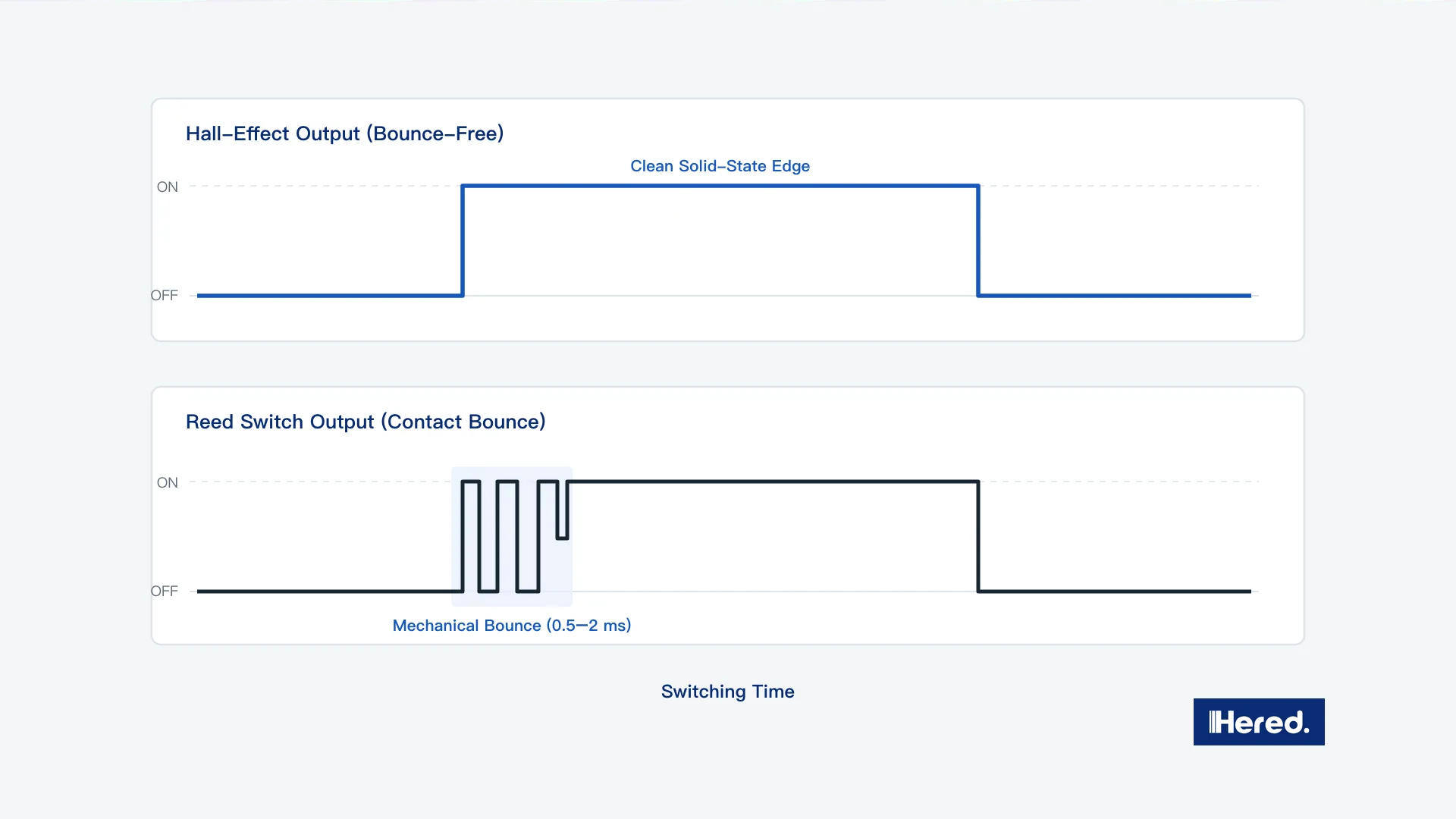
| Contact bounce | None (clean solid-state edge) | Present (typically 0.5–2 ms mechanical chatter) | Reed needs PLC debounce on fast counters |
| Supply & output wiring | 10–30 V DC 3-wire NPN or PNP | 2-wire AC/DC (up to 90–220 V AC or DC) | Reed simplifies legacy AC/DC retrofits |
| Quiescent power & off-state leakage | Draws continuous standby current | Passive contact; zero standby draw | Reed suits battery or ultra-low-leakage loops |
| Vibration & mechanical shock | Excellent (epoxy-potted solid state) | Sensitive to severe shock / high-G vibration | Stamping presses favor Hall-effect |
Choose a Hall-effect magnetic proximity sensor whenever the machine runs high switching frequencies, continuous vibration, or millions of annual cycles into a 24 V DC PLC; switch to a reed-switch magnetic sensor whenever you need a simple 2-wire AC/DC dry contact, zero off-state leakage current, or direct drop-in replacement on a low-speed legacy control circuit.
Contact Bounce, Switching Speed, and PLC Counter Accuracy
When a permanent magnet sweeps past a reed switch, the flexing ferromagnetic reeds rebound several times over 0.5 to 2 milliseconds before settling cleanly closed. On a slow door interlock or end-of-stroke indicator lamp, that brief bounce is invisible; on a high-speed PLC counter input or rotary shaft tachometer, a single pass of the magnet can register three to five false counts unless hardware RC filtering or software debounce delays are added.
Additionally, switching inductive loads (such as relay coils or solenoid valves) or long capacitive cables directly through a reed switch causes micro-arcing across the delicate blades, rapidly shortening life or welding the contacts permanently closed. Always add an external freewheeling diode (DC) or RC snubber (AC) when driving inductive loads with a reed switch, or move to a solid-state Hall sensor with built-in short-circuit and transient protection under IEC 60947-5-2.
Magnetic Wall Penetration: Aluminum, Stainless Steel, and Carbon Steel
One of the greatest engineering advantages of both Hall-effect and reed-switch magnetic sensors is their ability to detect a permanent magnet directly through sealed non-ferromagnetic walls—allowing position tracking inside pressurized aluminum housings, sealed sanitary vessels, or cleanroom enclosures without drilling through the barrier. However, wall alloy selection is critical because magnetic permeability dictates whether flux passes through or gets shunted away.
| Barrier Wall Material | Magnetic Behavior | Flux Penetration | Engineering Guideline |
|---|---|---|---|
| Aluminum (6061 / 6063 / cast) | Paramagnetic (non-ferrous) | Excellent (virtually unattenuated) | Ideal for cylinder barrels & sealed housings |
| Brass, copper, plastic, glass | Non-ferromagnetic | Excellent (full rated range) | Zero magnetic shunting; distance set by wall thickness |
| Austenitic stainless steel (304 / 316) | Non-magnetic (slight if cold-worked) | Good (minor attenuation) | Verify operating gap if wall is heavily cold-formed |
| Ferritic / martensitic stainless (400 series) | Ferromagnetic | Poor (shunts magnetic flux) | Significantly reduces range; bench-test required |
| Carbon steel / mild steel (Fe360) | Strongly ferromagnetic | Blocked (acts as magnetic shield) | Cannot reliably sense through solid steel plates |
Choose magnetic proximity sensing through aluminum, brass, polymer, or thin austenitic 304/316 stainless barriers whenever an inductive sensor would be blinded by the metal wall itself; never expect a standard magnetic sensor to see through solid carbon-steel plates without cutting a non-magnetic window or relocating the magnet.
External Hardware, Mounting Threads, and Output Wiring
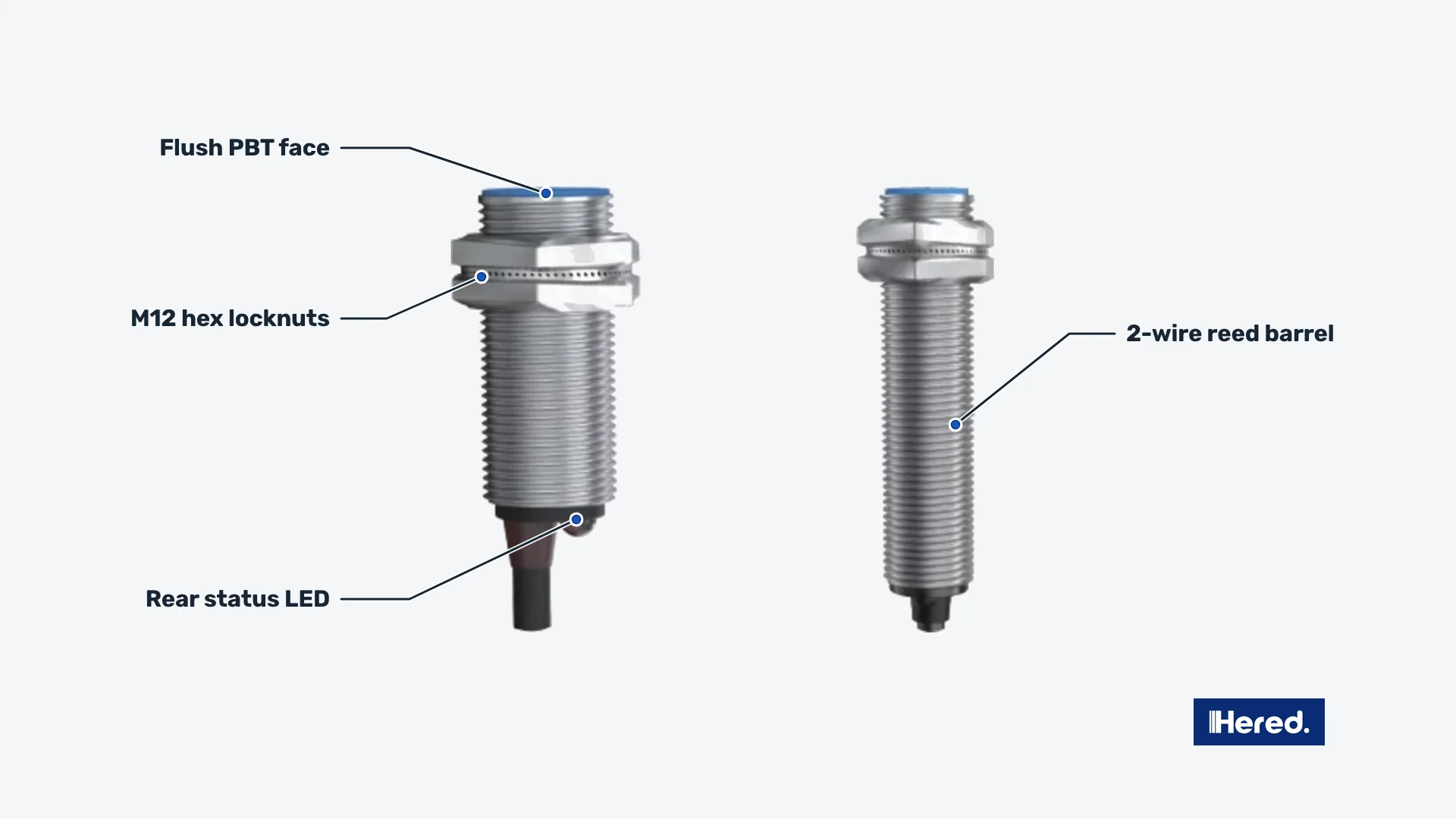
Externally, M12 and M18 cylindrical Hall-effect and reed-switch magnetic sensors share identical threaded nickel-plated housings, dual hex locknuts, IP67 epoxy potting, and flush PBT sensing faces—allowing direct drop-in interchangeability on existing proximity-sensor brackets. The practical difference lies in the cable exit and wiring: Hall-effect barrels require 3-wire DC NPN or PNP wiring matched to your PLC input card (see our NPN vs PNP Sensors Wiring Guide), while reed-switch barrels use 2-wire AC/DC wiring that connects directly in series with the load.
Matching HERED Hall-Effect and Reed-Switch Series to Your Machine
Across the HERED Magnetic Sensor Manufacturer Hub and HERED Magnetic Proximity Sensors catalog, five core M12 and M18 series cover solid-state Hall, wide-voltage industrial magnetic, and 2-wire reed-switch requirements:
| HERED Series | Technology | Verified Catalog Range | Supply & Output Options | Enclosure & Best-Fit Application |
|---|---|---|---|---|
| HERED HMH12 Series | Hall-Effect (6 models) | 10 mm ± 10% (flush) | 10–30 V DC 3-wire NPN / PNP (NO, NC, NO+NC) | IP67, M12 · High-speed DC PLC counting & vibration |
| HERED HMH18 Series | Hall-Effect (6 models) | 10 mm ± 10% (flush) | 10–30 V DC 3-wire NPN / PNP (NO, NC, NO+NC) | IP67, M18 · Heavy-duty automation & wide air gaps |
| HERED HMG10 Series | Industrial Magnetic (24 models) | 10 mm (flush) | 90–250 V AC / 10–30 V DC, 2-wire & 3-wire | IP67 · Multi-voltage OEM machinery & broad variants |
| HERED MR12 Series | Reed Switch (4 models) | 10 mm ± 10% (flush) | 90–220 V AC / 10–30 V DC, 2-wire NO / NC | IP67, M12 · Zero-leakage AC/DC retrofits & doors |
| HERED MR18 Series | Reed Switch (4 models) | 10 mm ± 10% (flush) | 90–220 V AC / 10–30 V DC, 2-wire NO / NC | IP67, M18 · Direct AC/DC relay loads & low-speed limits |
Choose HERED HMH12 or HERED HMH18 whenever high cycle life, shock resistance, and bounce-free 24 V DC PLC signaling are required; switch to HERED MR12 or HERED MR18 for passive 2-wire AC/DC switching, or specify HERED HMG10 for broad multi-voltage OEM coverage paired with mounting brackets from HERED Sensor Accessories.
Frequently Asked Questions
Can a Hall-effect or reed-switch sensor detect ordinary steel without a magnet?
No. Unlike inductive proximity sensors that generate their own magnetic field to detect plain carbon steel or aluminum, magnetic proximity sensors require an external permanent magnet (such as ferrite or neodymium NdFeB) mounted on the moving target to supply the triggering magnetic flux.
Does magnet polarity matter for Hall-effect vs. reed-switch sensors?
Unipolar Hall-effect sensors respond specifically to either the South or North pole facing the sensing face, so reversing the magnet prevents switching; omnipolar Hall sensors and all standard reed switches trigger on either magnetic pole, making orientation simpler during maintenance.
Why did my reed switch fail early when connected to a 24 V DC solenoid or long cable?
Inductive kickback voltage from a solenoid coil or capacitive inrush current from a long shielded cable creates micro-arcing across the thin reed blades at every switch cycle, eventually welding the contacts shut. Add a flyback diode or series current-limiting resistor, or upgrade to a solid-state Hall-effect sensor (HMH12/HMH18).
References
- International Electrotechnical Commission (IEC), IEC 60947-5-2:2019 — Low-voltage switchgear and controlgear — Part 5-2: Control circuit devices and switching elements — Proximity switches, IEC Webstore.
- International Electrotechnical Commission (IEC), IEC 60529 — Degrees of protection provided by enclosures (IP Code), IEC Webstore.
- HERED Electric, Magnetic Proximity Sensor Manufacturer Hub & Product Catalog (HMH12, HMH18, HMG10, MR12, MR18), HERED Electric.
Need help selecting the right industrial sensor?
Explore our 1,152+ catalogued inductive, photoelectric, capacitive, and magnetic proximity sensors or request factory cross-reference support.
DIRECT FACTORY RFQ
Need sensor pricing, samples, or OEM cross-reference?
Share your target material, sensing distance, NPN/PNP output, or model code. Our engineering team replies within 24 hours.