
Safety Light Curtain Selection Guide: Resolution, ISO 13855 & OSSD Wiring
Sizing a safety light curtain is a legal and mechanical calculation, not a guess. Configure finger (14 mm), hand (20 mm), body (40 mm), compact mini, and long-range perimeter curtains with compliant ISO 13855 mounting distance and dual OSSD relays.
14 / 20 / 40 mm Pitch
IEC 61496 & ISO 13855
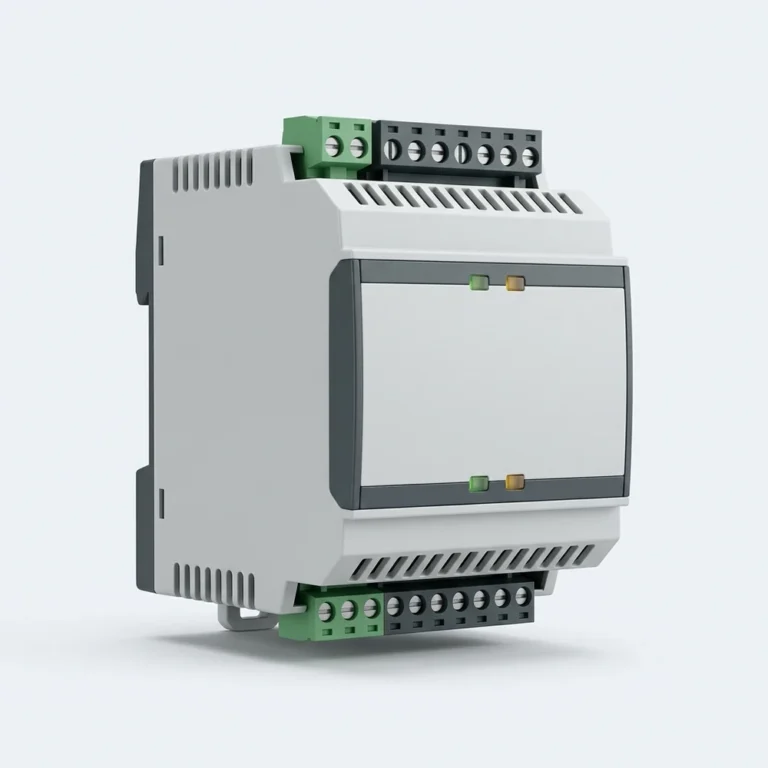
Dual OSSD + SLC-SR Relay
IP65 Aluminum Housing
Safety compliance warning: Buying a 40 mm beam-pitch curtain to save cost when an operator’s fingers sit 150 mm from a hydraulic press die fails ISO 13855 risk audits immediately. Resolution, protective height, machine stopping time, and dual-channel OSSD wiring must be engineered as one verified system — test your mounting distance live in our ISO 13855 Safety Curtain Distance Calculator.
1. Match Hazard Type to the Right HERED SLC Safety Light Curtain Series
Every safety light curtain application starts with the minimum detectable object size (resolution) defined by IEC 61496-2 and the physical machine access geometry. Compare all six published series in the HERED SLC Safety Light Curtain family:
| HERED Series | Optical Pitch / Resolution | Protected Body Part | Typical Operating Span | Key Mechanical & Application Role |
|---|---|---|---|---|
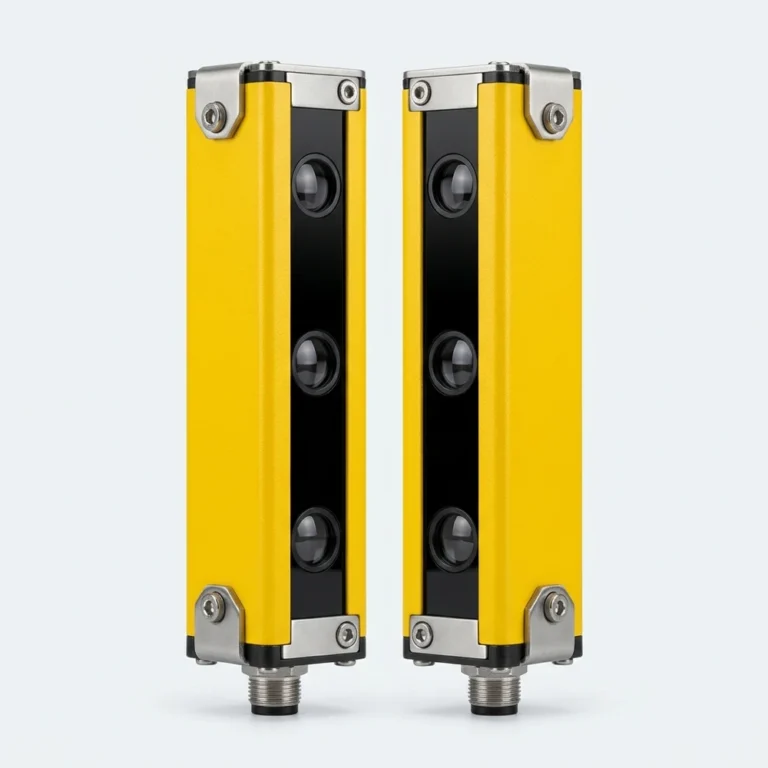
| SLC-14 Series | 14 mm (finger pitch) | Fingers & small hands | 0.3 – 6 m | Closest mounting to point of operation (punch presses, riveters, desktop assembly presses, ultrasonic welders) |
| SLC-20 Series | 20 mm (hand pitch) | Hands & wrists | 0.3 – 12 m | Most widely deployed general industrial guard (hydraulic presses, CNC load ports, packaging sealers, bending brakes) |
| SLC-40 Series | 40 mm (arm / body pitch) | Arms & full body | 0.5 – 15 m | Area and zone access guarding where operators cannot reach the hazard from outside the curtain plane |
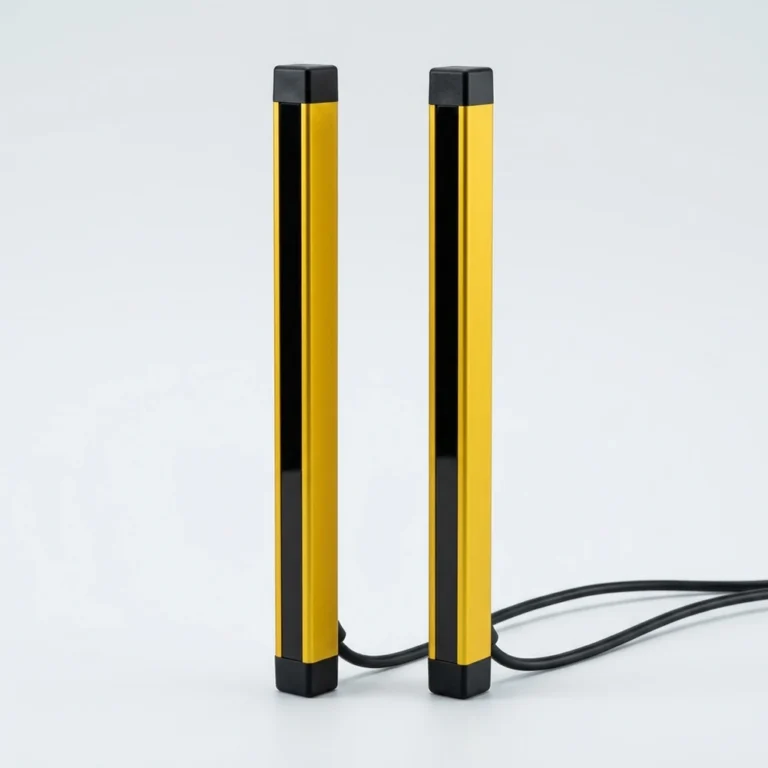
| SLC-M Series | Compact slim profile (14 / 20 mm options) | Fingers / hands in tight frames | 0.2 – 5 m | Small electronics assembly stations, laboratory automation, and tight enclosure openings with zero bracket overhang |
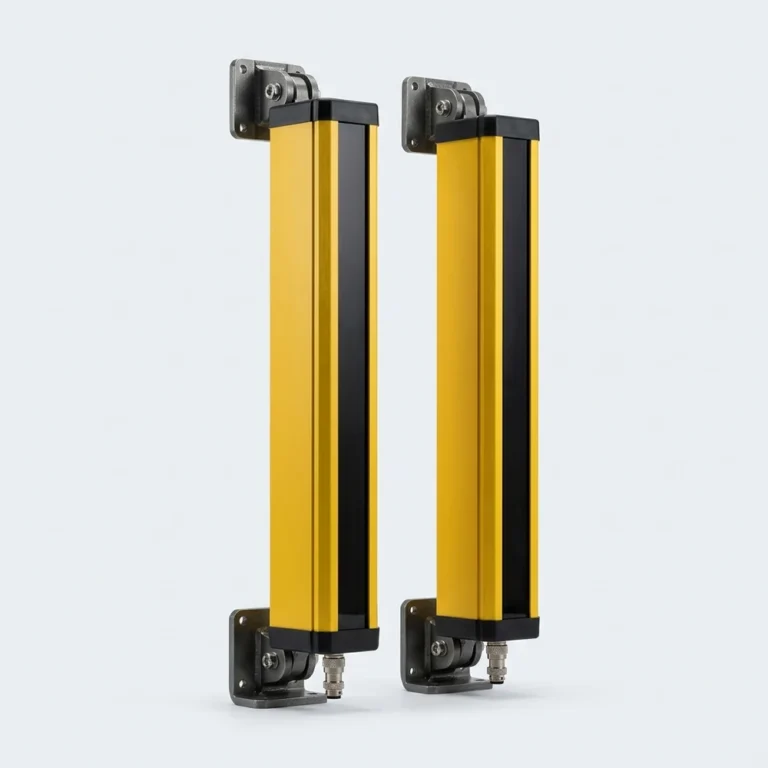
| SLC-LR Series | 2, 3, or 4 wide-spaced beams (300–500 mm pitch) | Full-body perimeter entry | Up to 20 m span | Large robot cells, palletizer entries, AGV transfer gates, and multi-sided perimeter guarding (with corner mirrors) |
| SLC-SR Controller | Dual-channel OSSD safety relay unit | System-level safe stop interface | 24 V DC / AC control cabinets | Converts dual PNP OSSD curtain outputs into force-guided safety relay contacts with EDM & manual reset |
2. Step 1: Perform Risk Assessment (IEC 61496 Type 2 vs. Type 4 & PL c / PL e)
Under ISO 13849-1 (Performance Level) and IEC 62061 (SIL), hazard severity, exposure frequency, and possibility of avoidance dictate whether your machine requires a Type 2 (up to PL c / SIL 1) or Type 4 (up to PL e / SIL 3) electro-sensitive protective equipment (ESPE) curtain:
- Type 4 (PL e / Category 4): Mandatory for irreversible high-severity hazards such as mechanical/hydraulic presses, press brakes, shears, and high-speed industrial robots. Single internal faults never compromise the safety function, and faults are detected immediately before or during the next demand.
- Type 2 (PL c / Category 2): Restricted to lower-severity, slower-moving hazards where periodic self-test intervals satisfy the machine risk assessment.
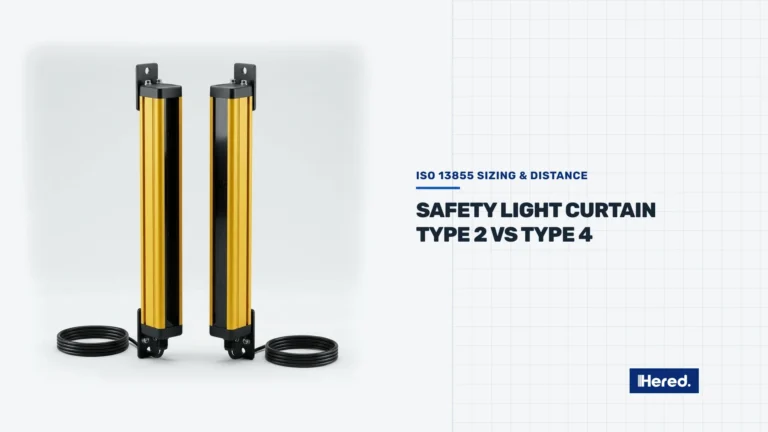
For a detailed engineering breakdown of Type 2 vs. Type 4 fault-detection cycles and certification criteria, read Safety Light Curtain Type 2 vs. Type 4: Sizing, Resolution & ISO 13855 Guide.
3. Step 2: Calculate Minimum Safety Mounting Distance (ISO 13855)
A safety light curtain only protects an operator if the machine comes to a complete stop before the operator’s hand or body reaches the pinch point. ISO 13855 defines the mandatory minimum safety distance S for perpendicular approach:
ISO 13855 Formula: S = (K × T) + C
Where K = approach speed (2,000 mm/s for resolution ≤ 40 mm when S ≤ 500 mm; 1,600 mm/s for body/perimeter or when S > 500 mm), T = total stopping time in seconds (curtain response time + safety relay time + machine mechanical braking time), and C = intrusion distance: C = 8 × (d − 14) for resolution d ≤ 40 mm (so C = 0 mm for 14 mm finger pitch, C = 48 mm for 20 mm hand pitch, C = 208 mm for 40 mm pitch, and C = 850 mm for multi-beam perimeter grids).
| Resolution (d) | Intrusion Factor (C) | Min Distance S at T = 150 ms | Min Distance S at T = 250 ms | Engineering Takeaway |
|---|---|---|---|---|
| 14 mm (SLC-14) | 0 mm | 300 mm | 500 mm | Allows tightest operator loading ergonomics near fast presses |
| 20 mm (SLC-20) | 48 mm | 348 mm | 548 mm (re-check at K=1600: 448 mm → min 500 mm) | Optimal cost/ergonomics balance for general hand guarding |
| 40 mm (SLC-40) | 208 mm | 508 mm (min 500 mm) | 608 mm (at K=1600) | Adds 208 mm penalty — only use when workspace depth allows |
| Multi-beam (SLC-LR) | 850 mm | 1,090 mm (at K=1600) | 1,250 mm (at K=1600) | Strictly for perimeter entry > 1 m outside hazardous motion |
Verify your exact machine stopping time and resolution immediately using our ISO 13855 Safety Distance Calculator.
4. Step 3: Size Protective Height, Beam Count & Anti-Bypass Mechanical Guarding
A common audit failure is choosing a curtain that is too short or leaves an unguarded gap above, below, or behind the optical plane:
- Protective height coverage: Ensure the guarded optical zone spans from the lowest reachable opening (typically ≤ 300 mm above floor or flush with the machine bolster table) up to at least 1,800–2,000 mm above floor level, or tie the top/bottom edges directly into rigid fixed guards so operators cannot reach over, under, or around the beams.
- Dead-zone check: Account for the housing end-caps when mounting inside tight press openings. Where end-cap dead space is critical, select the low-profile SLC-M Compact Mini Series.
- Step-behind hazard protection: If there is space for an operator to step completely past the vertical curtain and remain standing inside the danger zone (clearing the beams behind them), you MUST add a horizontal presence-sensing light curtain, a safety mat, or a mandatory manual reset pushbutton located outside the cell with full visual line-of-sight.
5. Step 4: Dual-Channel OSSD Wiring, Safety Relays & Optical Interference
- Never wire OSSD outputs directly to a standard PLC alone: Safety light curtains output two redundant self-checking PNP signals (OSSD1 and OSSD2) that emit microsecond dark-test pulses to detect short circuits to 24 V, ground, or each other. Wire both OSSD channels into a dedicated safety relay controller (SLC-SR) or a certified Safety PLC, and monitor downstream machine contactors via EDM (External Device Monitoring).
- Preventing shiny-surface false reflections: Glossy stainless steel guards, aluminum extrusion rails, or chrome machine frames positioned parallel to the optical beam path can reflect a beam around an operator’s hand, defeating detection! Keep reflective surfaces outside the sensor’s effective aperture angle (EAA) — typically ≥ 130 mm clear for short spans and ≥ 250–400 mm for longer spans — or paint adjacent machine faces matte dark gray.
- Adjacent machine crosstalk: When two presses sit side by side, alternate emitter/receiver positions or use optical synchronization coding so Press A’s emitter never illuminates Press B’s receiver.
6. Where Safety Light Curtains Are NOT the Right Solution
Ejected Parts, Welding Sparks & Coolant Splash
Light beams cannot physically stop flying metal chips, shattered grinding wheels, or hot weld spatter. Use interlocked polycarbonate/steel safety doors whenever projectile ejection is part of the risk assessment.
Machines That Cannot Stop Rapidly
Flywheel presses with full-revolution mechanical clutches or heavy high-inertia spindles that take 3+ seconds to coast down require impractical safety distances (> 5 m). Use interlocked physical guard doors with guard-locking switches instead.
Simple Non-Safety Part Counting
If you only want to count boxes or check pallet height on a conveyor without guarding personnel, a safety light curtain is unnecessary over-specification. Use an E3JK or E3Z photoelectric sensor.
Severe Steam, Fog, or Dense Airborne Dust
Dense water vapor or heavy woodworking/foundry dust can scatter infrared beams and cause nuisance machine stops. Add air-purge lens hoods or evaluate interlocked physical guarding.
7. Safety Light Curtain RFQ Checklist (7 Fields to Quote Correctly First Time)
When requesting pricing, dimensional drawings, or OEM customization from our Safety Light Curtain Manufacturer Hub, include these seven lines:
- Resolution / beam pitch: 14 mm finger (SLC-14), 20 mm hand (SLC-20), 40 mm body (SLC-40), or multi-beam (SLC-LR).
- Required protective height (mm): Total guarded span (e.g., 320 mm, 640 mm, 960 mm, 1,280 mm, 1,600 mm).
- Operating span (distance between emitter & receiver): e.g., 1.5 m press opening vs. 12 m palletizer cell.
- Output & controller requirement: Dual-channel PNP OSSD only, or bundled with SLC-SR safety relay controller + mounting brackets + shielded cables.
- Machine stopping time (ms): Allows our engineers to double-check your ISO 13855 mounting clearance.
- Environment & bracket space: Standard IP65 vs. compact slim housing (SLC-M), cable length needed.
- Order quantity or competitor part code: Sample count, annual machine build volume, or existing Omron F3SG, Sick deTec4, Keyence GL-R, or Banner EZ-SCREEN codes.
8. Frequently Asked Questions on Safety Light Curtain Selection
How do I choose between 14 mm, 20 mm, and 40 mm safety light curtain resolution?
Match resolution to the closest body part that can approach the hazard: choose 14 mm (SLC-14) when operators load parts with fingers right next to the die; choose 20 mm (SLC-20) for standard hand protection mounted 350–550 mm away; choose 40 mm (SLC-40) or multi-beam (SLC-LR) for arm/body access further from the danger zone.
Can I connect a safety light curtain directly to a standard 24 V DC PLC input?
No. A standard non-safety PLC cannot serve as the sole safety stop controller. Always wire the curtain’s dual OSSD1/OSSD2 outputs into a certified safety relay (SLC-SR) or a rated Safety PLC that cuts main actuator power through dual redundant contactors.
How do I calculate the number of beams for a given protective height?
Protective height equals roughly (Number of Beams − 1) × Beam Pitch. For example, a 20 mm pitch curtain with 32 beams provides 620 mm of optical protection height. Share your exact machine opening dimensions in the RFQ form below and we will match the closest standard SLC height.
What happens if a shiny metal machine frame sits close to the light curtain?
A glossy parallel surface inside the curtain’s effective aperture angle can bounce infrared light around an operator’s hand, creating a dangerous blind spot. Maintain clearance per the installation manual or install matte dark shielding baffles along adjacent reflective surfaces.
Does Hered Electric supply complete kits with cables, brackets, and safety relays?
Yes. Every SLC emitter/receiver pair can ship as a plug-and-play machine kit including side/top L-brackets, shielded M12/aviation connection cables, and the matched SLC-SR dual-channel safety relay controller.
PUBLISHED HERED SERIES
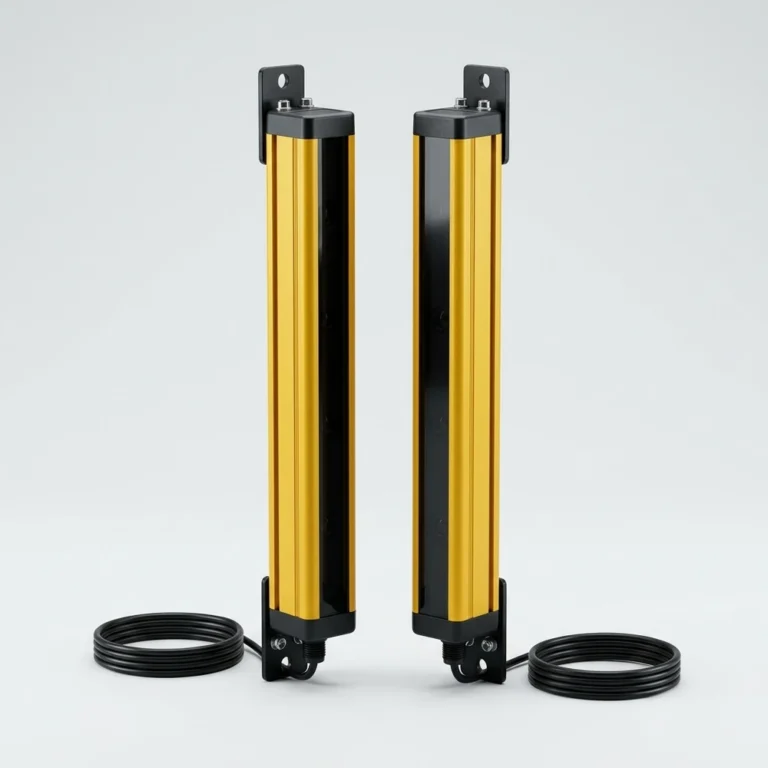
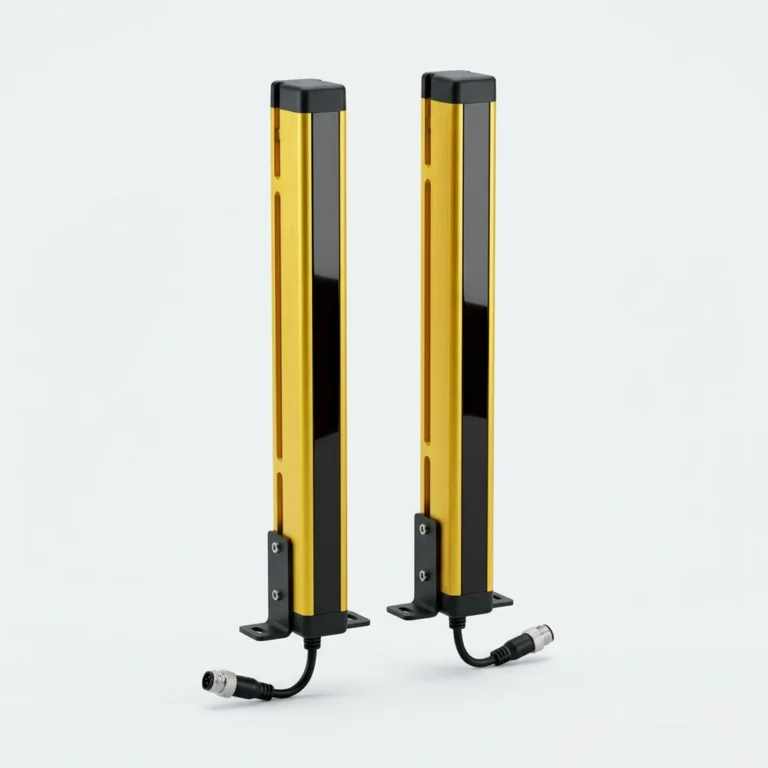
Recommended Safety Light Curtains Series
DEEP-DIVE TECHNICAL COMPARISONS
Related Engineering Articles
ENGINEERING RFQ & SAMPLE SUPPORT
Send Your Safety Light Curtain Selection Requirements for a Direct Factory Quote
Share the parameters from this guide (target material, required range, housing size, output type, and quantity). Hered Electric engineering reviews every inquiry before quoting.
- Fast cross-reference: Send Omron, Sick, Pepperl+Fuchs, Autonics, or Turck part codes for pin-compatible HERED series.
- No-guesswork sizing: Include target metal/medium, mounting clearance, and PLC input type (sinking/sourcing).
- Direct contact: [email protected] · WhatsApp +86 180 6639 6588